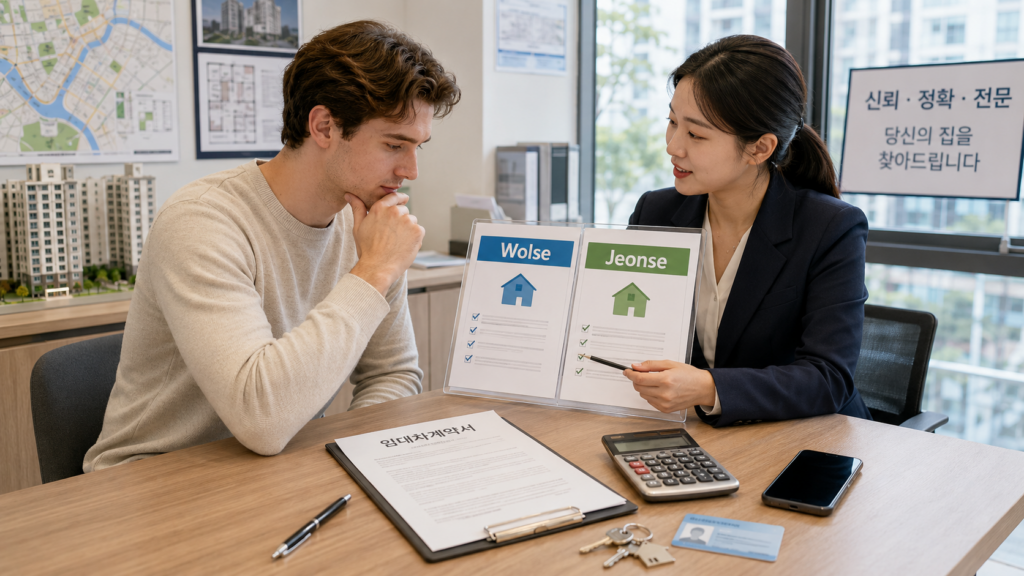
Rent an apartment in Korea as a foreigner can feel confusing at first because the Korean housing system works differently from many other countries.
You may see words like wolse, jeonse, deposit, key money, maintenance fee, real estate agent fee, lease report, fixed date, and address change. These terms can feel overwhelming if you are new to Korea.
But the process becomes much easier when you understand the basic flow.
First, choose the right housing type.
Then compare the deposit and monthly rent.
Check the contract carefully.
Confirm the real estate agent and fees.
Sign the lease only after checking the important details.
After moving, update your address and keep your housing documents safe.
If you recently received your Residence Card, read this guide too: Korean Residence Card for Foreigners: 2026 Guide.
If you moved to a new address, you may also need this guide: Report Address Change in Korea as a Foreigner.
If you are opening a bank account for rent payment, read: Open a Bank Account in Korea as a Foreigner.
Quick Answer
To rent an apartment in Korea as a foreigner, you usually need to understand these things first.
Your housing type
Your deposit amount
Your monthly rent
Your maintenance fee
Your lease period
Your Korean address
Your Residence Card status
Your payment method
Your real estate agent fee
Your lease contract terms
Your address change reporting duty after moving
The most common rental type for foreigners is usually wolse, which means paying a deposit plus monthly rent.
Jeonse is another Korean rental system where the tenant pays a much larger deposit instead of monthly rent, but it can be harder and riskier for foreigners who are new to the Korean housing system.
Before signing any contract, check the total monthly cost, deposit return conditions, maintenance fee, contract period, landlord information, real estate agent details, and whether the address can be used for your Residence Card and address change report.
The safest approach is simple.
Do not only look at the monthly rent.
Check the deposit, contract, building, agent, and address documents together.
Why Renting in Korea Feels Different
Renting in Korea can feel different because the deposit is often much larger than what many foreigners expect.
In some countries, tenants pay one or two months of rent as a security deposit.
In Korea, the deposit can be much higher. Even a simple one-room studio can require a deposit of several million won, and larger homes may require much more.
Also, the monthly rent may not be the only monthly cost.
You may also pay:
Maintenance fee
Electricity
Gas
Water
Internet
Building management fee
Parking fee
Cleaning or waste-related fees
Heating costs
Elevator or security fees
This is why you should always ask for the full monthly cost, not just the rent.
Useful question:
What is the total monthly cost including rent and maintenance fee?
In Korean:
월세와 관리비를 포함한 한 달 총 비용이 얼마인가요?
Common Housing Types in Korea
Korea has several common housing types. The right choice depends on your budget, stay length, location, and lifestyle.
One-room studio
A one-room is one of the most common choices for students, working holiday makers, and single foreign residents.
It usually includes one main room, a small kitchen area, and a bathroom.
Good for:
Students
Single workers
People on a budget
People who want simple housing
Short to medium-term stays
Things to check:
Ventilation
Heating
Mold
Noise
Laundry space
Window size
Water pressure
Maintenance fee
Internet included or not
Officetel
An officetel is a building type that combines office and hotel-style functions. Many are used as residential spaces.
Officetels are often popular among office workers and single-person households because they may include built-in appliances and convenient locations.
Good for:
Workers
Single residents
People who want built-in appliances
People who want better security
People who prefer a building with elevators and management
Things to check:
Higher maintenance fee
Parking cost
Heating and cooling cost
Whether residential use is allowed
Deposit and management fee details
Apartment
Apartments are common among Korean families and long-term residents.
They are usually larger and located in apartment complexes with management offices and shared facilities.
Good for:
Families
Long-term residents
People who need more space
People who want stable facilities
People living with spouse or children
Things to check:
Large deposit
Higher monthly total cost
Management fee
Parking
Elevator
School or transportation access
Contract period
Villa or multi-family house
A villa or multi-family house may be cheaper than a large apartment and can be found in many neighborhoods.
Good for:
Budget-conscious renters
People wanting more space than one-room
People living outside major apartment areas
Things to check:
Building age
Security
Stairs
Parking
Mold
Soundproofing
Maintenance responsibility
Deposit safety
Goshiwon or share house
A goshiwon or share house can be useful for very short stays or low-budget living.
Good for:
Short stays
Students
People arriving before finding long-term housing
People who do not want a large deposit
Things to check:
Room size
Shared bathroom
Kitchen rules
Noise
Contract flexibility
Address registration possibility
Fire safety
Privacy
Wolse vs Jeonse: The Two Big Rental Types
When you rent housing in Korea, you will often hear two words.
Wolse
Jeonse
These are very important.
What is wolse?
Wolse means monthly rent.
Usually, you pay a deposit first, then pay monthly rent every month.
Example:
Deposit: KRW 5,000,000
Monthly rent: KRW 600,000
Maintenance fee: KRW 80,000
In this case, your monthly housing cost is not just KRW 600,000. It may be KRW 680,000 or more, depending on utilities and fees.
Wolse is usually easier for foreigners because the deposit is smaller than jeonse.
What is jeonse?
Jeonse is a Korean rental system where the tenant pays a very large deposit and usually does not pay monthly rent.
At the end of the contract, the landlord is supposed to return the deposit.
Jeonse can be attractive because there is no monthly rent, but it requires a large amount of money and careful risk checking.
For foreigners who are new to Korea, jeonse can be difficult because you need to understand deposit protection, building debt, landlord risk, contract reporting, and legal procedures.
Which one is better for foreigners?
For many foreigners, wolse is the more practical starting point.
It usually requires less upfront money and is easier to understand.
Jeonse may be possible for long-term residents, but it should be approached carefully.
If you are new to Korea, do not choose jeonse only because it looks cheaper monthly. The deposit risk matters.
Deposit, Monthly Rent, and Maintenance Fee
When you compare homes in Korea, do not compare only monthly rent.
Always calculate the full cost.
Deposit
The deposit is money you pay before moving in.
It is usually returned after the contract ends, but unpaid rent, unpaid utilities, damage, or contract disputes may affect the final return.
Before paying a large deposit, check the contract carefully.
Monthly rent
Monthly rent is the amount you pay every month.
Ask exactly when rent is due and which bank account you should send it to.
Keep transfer records.
Do not pay rent in cash without a receipt.
Maintenance fee
Maintenance fee is called 관리비 in Korean.
It may include some building-related costs, but the details can vary a lot.
Ask what is included.
Possible items include:
Internet
Water
Elevator
Cleaning
Security
Trash
Building management
Shared electricity
Heating or hot water
Parking
Useful Korean sentence:
관리비에 어떤 항목이 포함되어 있나요?
Meaning:
What is included in the maintenance fee?
Documents Foreigners May Need
Documents can vary depending on the landlord, real estate agent, housing type, and your visa status.
Common documents may include:
Passport
Residence Card
Korean phone number
Korean bank account
Proof of employment or school enrollment
Emergency contact
Deposit payment proof
Previous address or current address information
Some landlords may be flexible.
Others may prefer tenants who have a Residence Card, Korean phone number, and Korean bank account.
If you are a student, your school may help with housing documents.
If you are working, your employer may help explain your employment status to the landlord.
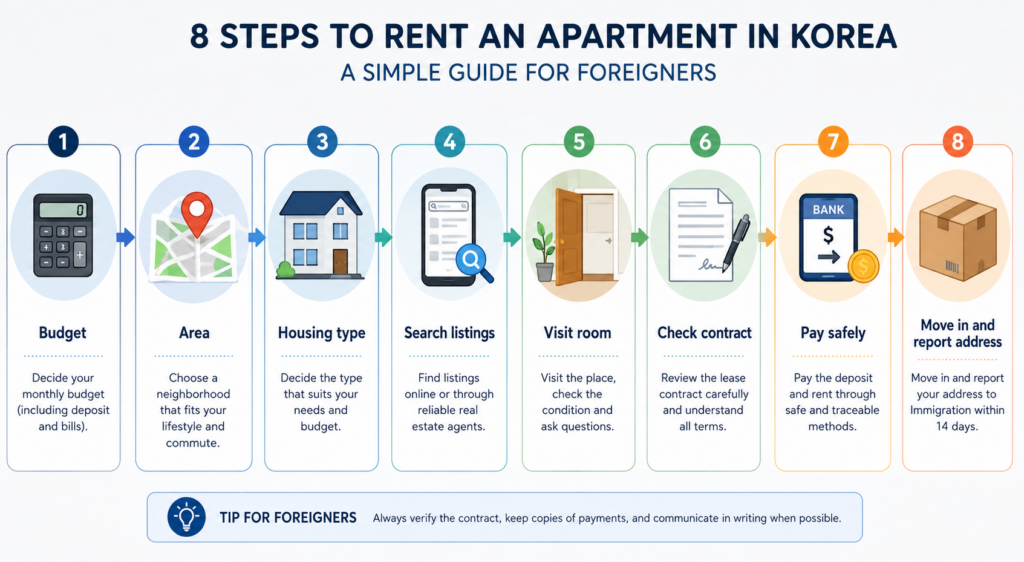
Step-by-Step: How to Rent an Apartment in Korea as a Foreigner
Step 01) Decide your budget
Start with your real budget.
Do not only think about monthly rent.
Include:
Deposit
Monthly rent
Maintenance fee
Utilities
Brokerage fee
Moving cost
Furniture
Internet
Transportation cost
Emergency money
A cheap room far from work or school may cost more in transportation and time.
Step 02) Choose the area
Choose an area based on daily life.
Check:
Distance to work or school
Subway or bus access
Supermarkets
Hospitals
Safety at night
Noise
Hill or flat roads
Language support
Distance from immigration office or bank
Delivery availability
Visit the area at different times if possible.
A neighborhood can feel very different during the day and at night.
Step 03) Choose housing type
Decide whether you want a one-room, officetel, apartment, villa, goshiwon, or share house.
For most first-time foreign renters, one-room or officetel is often easier.
For families, apartments may be better.
For very short stays, goshiwon or share house may be more flexible.
Step 04) Search listings
You can search through:
Local real estate offices
Housing apps
School housing boards
Foreigner community groups
Company or school recommendations
Serviced residence providers
Share house platforms
Be careful with listings that look too cheap compared to similar homes in the area.
If the price looks too good, ask why.
Step 05) Visit the room in person
Do not sign only based on photos if possible.
When visiting, check:
Mold
Smell
Noise
Water pressure
Hot water
Heating
Air conditioning
Windows
Door lock
CCTV
Elevator
Trash area
Laundry space
Sunlight
Phone signal
Internet availability
Take photos or videos during the visit.
Step 06) Check the contract details
Before signing, check:
Address
Landlord name
Tenant name
Deposit
Monthly rent
Maintenance fee
Payment date
Contract period
Move-in date
Move-out rules
Repair responsibility
Early termination rule
Deposit return timing
Included furniture or appliances
Special terms
Do not sign if you do not understand the special terms.
Special terms can be very important in Korean contracts.
Step 07) Pay safely
Usually, you may pay a contract deposit first and the remaining deposit before or on move-in day.
Use bank transfer when possible.
Keep records of all payments.
Do not send money to a personal account that does not match the contract without asking questions.
Ask the real estate agent to explain whose account it is.
Step 08) Move in and report address
After moving, update your address if required.
If you have a Residence Card, you may need to report your new address after moving.
Read this guide: Report Address Change in Korea as a Foreigner.
Also update important services:
Bank
Mobile carrier
School
Employer
Delivery apps
Insurance
Healthcare-related services
What to Check Before Signing the Lease
This is one of the most important sections.
Before signing, check these items carefully.
Check the exact address
Make sure the address on the contract matches the actual place you visited.
Check building name, room number, floor, and road-name address.
This address may later be used for your Residence Card address change report.
Check the landlord information
Ask who the landlord is.
Check whether the person receiving the deposit is the correct person.
If the bank account name is different from the landlord name, ask why.
Check the deposit and rent
Confirm:
Deposit amount
Contract payment
Remaining deposit payment date
Monthly rent
Maintenance fee
Payment deadline
Payment account
Late payment rule
Check the maintenance fee
Ask what the maintenance fee includes.
A room with low rent but high maintenance fee may not be cheap.
Check repair responsibility
Ask who pays for repairs.
For example:
Boiler issue
Air conditioner issue
Water leak
Door lock
Appliances
Wall damage
Floor damage
Mold
Write important agreements into the contract if possible.
Check early termination rule
If you leave Korea early, change job, change school, or move to another city, you need to know what happens.
Ask:
Can I end the contract early?
Do I need to find a replacement tenant?
Will I lose part of my deposit?
How much notice should I give?
Check furniture and appliances
If the room includes furniture or appliances, list them.
Examples:
Bed
Desk
Chair
Washing machine
Refrigerator
Air conditioner
Microwave
Induction stove
Wardrobe
Take photos on move-in day.
Real Estate Agent and Brokerage Fee
Many foreigners use a real estate agent, called 부동산 or 공인중개사.
A good agent can help you find rooms, explain contracts, and coordinate with the landlord.
But you still need to understand the fee.
Brokerage fees in Korea are not random. There are official maximum rates depending on the transaction type and amount.
For housing leases in Seoul, the maximum rate depends on the transaction value. For monthly rent, the transaction value is generally calculated using the deposit and monthly rent.
Before signing, ask the agent:
How much is the brokerage fee?
In Korean:
중개보수는 얼마인가요?
Also ask:
Can I get a receipt?
In Korean:
영수증 받을 수 있나요?
Do not assume the fee is included in the rent.
The tenant often pays a brokerage fee separately.
Housing Lease Contract Reporting System
Some Korean housing lease contracts must be reported.
This is called the Housing Lease Contract Reporting System, or Jeonse and Monthly Rent Reporting System.
In simple words, certain housing lease contracts must be reported to the relevant authority within 30 days from the contract signing date.
The Seoul Foreign Portal explains that the reporting duty can apply when the contract is for residential housing, signed on or after June 2021, located in a covered area, and the deposit exceeds KRW 60 million or monthly rent exceeds KRW 300,000.
If your contract is subject to reporting, both landlord and tenant are responsible for reporting. However, if one party submits the lease contract to the community service center, it may be considered jointly filed.
This system matters because the lease report can help prove the lease relationship and may automatically issue a fixed date.
Ask your real estate agent or local office:
Does this lease contract need to be reported?
In Korean:
이 임대차계약은 전월세 신고 대상인가요?
Address Change After Moving
After moving, foreigners often forget one important step.
Address change reporting.
If you are a registered foreign resident and move to a new address, you may need to report your new address.
This is connected to your Residence Card record.
Your lease contract can be important proof of residence.
You may need:
Residence Card
Passport
Lease contract
Proof of residence
Accommodation confirmation, if the lease is not under your name
Do not assume your landlord or real estate agent reports your immigration address for you.
You should confirm it yourself.
Read: Report Address Change in Korea as a Foreigner.
How to Protect Yourself Before Paying a Large Deposit
This part is especially important.
Korea’s rental deposits can be large, and deposit return problems can happen.
This does not mean every rental is dangerous.
But you should be careful before paying a large deposit.
Check the property carefully
Ask the real estate agent to help check basic property information.
You may want to check whether the landlord name, building information, and contract details are consistent.
Be careful with very large deposits
If you are new to Korea, avoid putting too much of your money into a deposit you do not fully understand.
A lower deposit with higher monthly rent may feel more expensive monthly, but it can reduce your deposit risk.
Keep all records
Keep:
Contract copy
Payment records
Agent receipt
Text messages
Move-in photos
Maintenance fee details
Repair agreements
Deposit payment proof
Rent transfer history
Do not rush
If someone says you must pay immediately or the room will disappear, slow down.
Good rooms can go fast, but pressure is also a common reason people make mistakes.
Ask for time to check the contract.
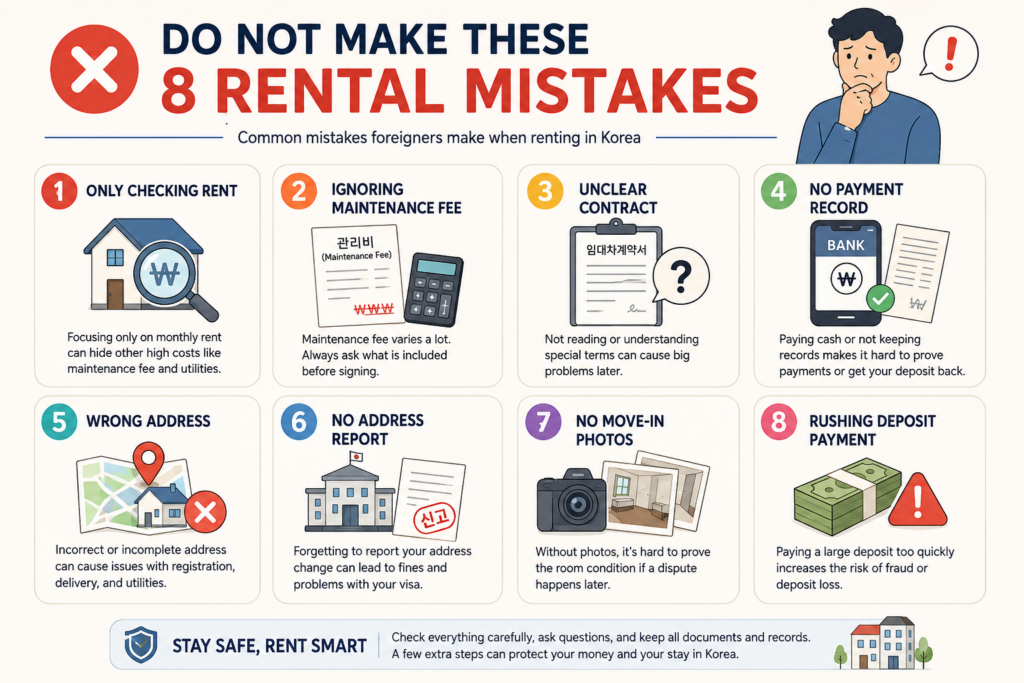
Common Mistakes Foreigners Make
Looking only at monthly rent
A KRW 500,000 rent may not be cheap if the maintenance fee is high and transportation is expensive.
Not checking the maintenance fee
Always ask what is included and what is separate.
Not reading special terms
Special terms can affect deposit return, repair responsibility, early move-out, cleaning fees, and furniture damage.
Paying cash without proof
Use bank transfer when possible.
If you must pay cash, get a receipt.
Signing a contract without understanding the address
The address matters for Residence Card, address change report, delivery, utilities, and banking records.
Forgetting address change reporting
After moving, update your immigration address if required.
Assuming the agent handles everything
A real estate agent may help with the lease, but your immigration, bank, phone, and address records are still your responsibility.
Not taking move-in photos
Photos can help if there is a dispute about damage later.
Useful Korean Sentences for Renting
To ask about total monthly cost
월세와 관리비를 포함한 한 달 총 비용이 얼마인가요?
What is the total monthly cost including rent and maintenance fee?
To ask what maintenance fee includes
관리비에 어떤 항목이 포함되어 있나요?
What is included in the maintenance fee?
To ask about the deposit
보증금은 계약 종료 후 언제 반환되나요?
When will the deposit be returned after the contract ends?
To ask about early termination
계약 기간 중간에 나가야 하면 어떻게 되나요?
What happens if I need to move out before the contract ends?
To ask about address registration
이 주소로 외국인등록증 체류지 변경 신고가 가능한가요?
Can I report this address for my Residence Card address change?
To ask about lease reporting
이 임대차계약은 전월세 신고 대상인가요?
Is this lease contract subject to housing lease contract reporting?
To ask about brokerage fee
중개보수는 얼마인가요?
How much is the brokerage fee?
To ask for a receipt
영수증 받을 수 있나요?
Can I get a receipt?
To ask about repairs
고장이나 수리가 필요하면 누가 비용을 부담하나요?
Who pays if something breaks or needs repair?
Checklist Before Signing
Before signing a Korean rental contract, check this list.
You saw the room in person.
You checked the exact address.
You checked the deposit.
You checked monthly rent.
You checked maintenance fee.
You asked what utilities are separate.
You checked contract period.
You checked early termination rule.
You checked deposit return timing.
You checked repair responsibility.
You checked furniture and appliances.
You checked landlord and payment account.
You asked about brokerage fee.
You asked whether lease reporting is required.
You confirmed whether the address can be used for Residence Card address reporting.
You took photos before moving in.
You kept all payment records.
FAQ
Can foreigners rent an apartment in Korea?
Yes. Foreigners can rent housing in Korea. However, the process may be easier if you have a Residence Card, Korean phone number, Korean bank account, and clear payment method.
What is the easiest housing type for foreigners?
For many single foreigners, one-room studios and officetels are often easier than large apartments. Students may also use dormitories or share houses.
What is wolse?
Wolse is monthly rent. You usually pay a deposit first and then pay rent every month.
What is jeonse?
Jeonse is a Korean rental system where the tenant pays a large deposit instead of monthly rent. It requires careful checking because the deposit amount can be very large.
Is jeonse safe for foreigners?
Jeonse is not automatically unsafe, but it can be risky if you do not understand deposit protection, landlord debt, contract reporting, and legal procedures. New foreigners should be careful.
Do I need a Residence Card to rent?
Not always, but many landlords and agents may ask for it. A Residence Card can also be important for address change reporting and other services.
What is maintenance fee?
Maintenance fee is a monthly building or management-related fee. It may include some utilities or shared services, but the included items vary by property.
Do I need to report my lease contract?
Some housing lease contracts must be reported within 30 days if they meet certain conditions. Ask your agent or local office whether your contract is subject to reporting.
Do I need to report address change after moving?
If you are a registered foreign resident, you may need to report your new address after moving. Do not assume the landlord or agent does this for you.
Should I use a real estate agent?
Using a licensed real estate agent can be helpful, especially if you do not speak Korean. But you should still check the contract, fee, payment records, and address documents yourself.
Final Thoughts
Rent an apartment in Korea as a foreigner becomes much easier when you understand the system before signing.
The biggest mistake is focusing only on rent.
You also need to check the deposit, maintenance fee, contract period, address, landlord information, brokerage fee, lease reporting duty, and address change reporting after moving.
For many foreigners, the safest first rental is usually a simple wolse contract with a manageable deposit, clear maintenance fee, and documents that can be used for Residence Card address reporting.
Do not rush the contract.
Check the room.
Check the address.
Check the contract.
Check the payment records.
Check what you must do after moving.
A good housing setup can make your life in Korea much smoother.
Once your home, Residence Card, phone number, bank account, and address record are connected correctly, daily life becomes much easier.