Wolse vs Jeonse for foreigners is one of the most important topics to understand before renting a home in Korea.
If you are used to a simple rental system where you pay one or two months of deposit and monthly rent, Korean housing can feel confusing at first.
In Korea, you may see listings with a deposit and monthly rent, a very large deposit with no monthly rent, or a mixed structure between the two.
These are usually called:
Wolse
Jeonse
Banjeonse
Wolse and jeonse are two of the most important rental systems to understand before signing a Korean lease.
Understanding these terms can help you compare homes more safely, avoid misunderstanding the real cost, and protect your deposit before signing a contract.
If you have not read the main rental guide yet, start here first: Rent an Apartment in Korea as a Foreigner.
If you need to report your new address after moving, read this guide too: Report Address Change in Korea as a Foreigner.
If you are preparing your Residence Card, this guide may help: Korean Residence Card for Foreigners: 2026 Guide.
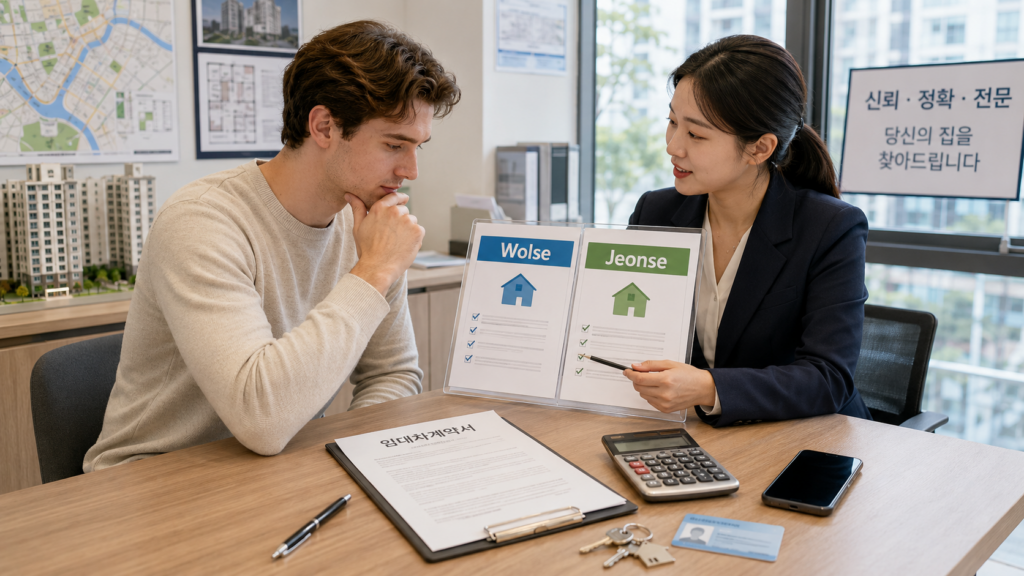
Quick Answer
Wolse means monthly rent in Korea.
With wolse, you usually pay a deposit first and then pay rent every month.
Jeonse means key money deposit lease.
With jeonse, you usually pay a much larger deposit and do not pay monthly rent during the lease period. The landlord is expected to return the deposit at the end of the contract.
For many foreigners new to Korea, wolse is usually easier to understand because the deposit is smaller and the structure is closer to monthly rent in other countries.
Jeonse can be useful for long-term residents, but it requires much more caution because the deposit is large and deposit return risk matters.
Banjeonse is a mixed type between wolse and jeonse. It usually has a higher deposit than normal wolse but lower monthly rent.
The simple rule is this:
If you are new to Korea, start with wolse unless you fully understand the jeonse deposit risk and contract protection steps.
Why This Matters Before You Sign a Lease
Wolse and jeonse are not just different payment styles.
They create very different risks.
With wolse, your biggest concern is usually monthly affordability.
With jeonse, your biggest concern is usually deposit safety.
A wolse contract may feel more expensive every month, but the deposit is usually smaller.
A jeonse contract may feel attractive because there is no monthly rent, but the deposit can be very large. If the landlord has financial problems, if the property has debt, or if the contract is not checked carefully, getting the deposit back can become difficult.
That is why foreigners should not compare rental listings only by monthly rent.
You need to compare:
Deposit
Monthly rent
Maintenance fee
Lease period
Brokerage fee
Deposit return conditions
Lease reporting duty
Fixed date
Address reporting
Landlord and property risk
A cheap-looking listing can become risky if you do not understand the deposit structure.
What Is Wolse?
Wolse is the Korean monthly rent system.
It usually works like this:
You pay a deposit before moving in.
You pay monthly rent every month.
You may also pay maintenance fee and utilities.
At the end of the lease, your deposit is usually returned after deducting unpaid rent, unpaid utilities, damage, or agreed costs if applicable.
Example:
Deposit: KRW 5,000,000
Monthly rent: KRW 600,000
Maintenance fee: KRW 80,000
In this example, your monthly housing cost is not only KRW 600,000.
Your real monthly cost may be KRW 680,000 plus utilities that are not included in the maintenance fee.
Why wolse is common for foreigners
Wolse is often easier for foreigners because the deposit is usually lower than jeonse.
It is more similar to rental systems in many other countries.
It may be better for:
Students
Short to medium-term residents
Working holiday makers
People with limited savings
People new to Korea
People who do not want to risk a large deposit
People who may move again soon
What to check in a wolse contract
Before signing a wolse contract, check:
Deposit amount
Monthly rent
Maintenance fee
What utilities are included
Payment date
Contract period
Early termination rule
Deposit return timing
Repair responsibility
Address registration possibility
Brokerage fee
Useful Korean sentence:
월세와 관리비를 포함한 한 달 총 비용이 얼마인가요?
Meaning:
What is the total monthly cost including monthly rent and maintenance fee?
What Is Jeonse?
Jeonse is a Korean rental system where the tenant pays a large lump-sum deposit to the landlord.
Instead of paying monthly rent, the tenant lives in the home during the contract period, and the landlord should return the deposit when the contract ends.
Jeonse is one of the most unique parts of the Korean housing system.
Example:
Jeonse deposit: KRW 150,000,000
Monthly rent: KRW 0
Maintenance fee: separate
At first, jeonse may look very attractive because there is no monthly rent.
But the deposit is very large.
This means the main issue is not monthly affordability. The main issue is deposit safety.
Why jeonse can be difficult for foreigners
Jeonse can be difficult if you are new to Korea because you need to understand:
Large deposit risk
Landlord financial condition
Property debt
Priority rights
Fixed date
Move-in report
Lease contract reporting
Deposit return timing
Housing Lease Protection Act basics
What to do if the landlord delays deposit return
Many foreign residents do not have enough Korean-language ability or local legal knowledge to check these things alone.
This does not mean foreigners should never use jeonse.
It means jeonse should be handled carefully.
When jeonse may make sense
Jeonse may make sense if:
You are staying in Korea long-term
You understand the contract
You can check property risk
You have enough cash or approved loan
You can get help from a trusted professional
You know how to protect your deposit
You understand fixed date and reporting steps
You are not rushing into the contract
If you do not understand these points, wolse may be a safer starting point.
What Is Banjeonse?
Banjeonse means a mixed rental structure between wolse and jeonse.
It usually has:
A larger deposit than normal wolse
Lower monthly rent than normal wolse
Example:
Deposit: KRW 30,000,000
Monthly rent: KRW 300,000
Banjeonse can be useful for people who have some savings and want to reduce monthly rent but do not want to pay a full jeonse deposit.
For many foreigners, banjeonse may be a middle option.
But the same rule still applies.
The higher the deposit, the more carefully you should check deposit safety.
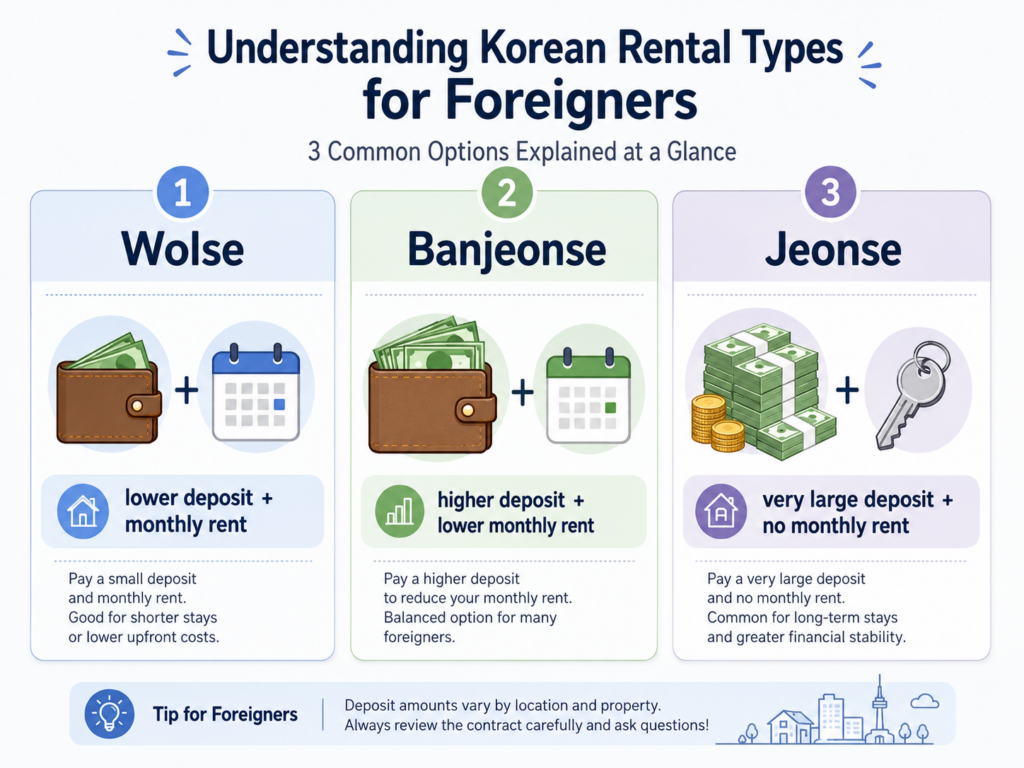
Wolse vs Jeonse: Main Differences
Here is the simple comparison.
| Item | Wolse | Jeonse |
|---|---|---|
| Deposit | Smaller | Much larger |
| Monthly rent | Yes | Usually no |
| Monthly burden | Higher | Lower |
| Upfront cash needed | Lower | Very high |
| Risk focus | Monthly affordability | Deposit return |
| Easier for beginners | Usually yes | Usually no |
| Common for students | Yes | Less common |
| Better for short stay | Usually yes | Usually no |
| Needs careful legal check | Yes | Strongly yes |
Wolse is easier to understand because you can compare monthly cost.
Jeonse can be harder because the real risk is hidden in the deposit and property condition.
For foreigners, the question is not only:
Which one is cheaper?
The better question is:
Which one is safer and realistic for my situation?
Which Is Better for Foreigners?
There is no one answer for everyone.
But here is a practical guide.
If you are staying less than one year
Wolse, serviced residence, share house, or goshiwon may be more realistic.
Full jeonse usually does not make sense for short stays because the deposit is too large and the contract may be harder to manage.
If you are a student
Wolse, dormitory, share house, or one-room rental is usually easier.
A lower deposit is often more practical.
If your school has an international office, ask whether they provide housing support or document guidance.
If you are working in Korea
Wolse or banjeonse can work depending on your salary and savings.
If you have a stable job and plan to stay long-term, jeonse may be possible, but you should check the property and contract very carefully.
If you are a family
Apartments may involve higher deposits.
Wolse, banjeonse, or jeonse may all appear depending on the area.
Because family housing deposits can be large, contract checking becomes more important.
If you are new to Korea
Start with wolse if possible.
It is easier to understand, easier to compare, and usually requires less upfront money.
You can consider other options later when you understand the Korean housing system better.
How to Calculate the Real Monthly Cost
Do not compare listings only by monthly rent.
Calculate the real cost.
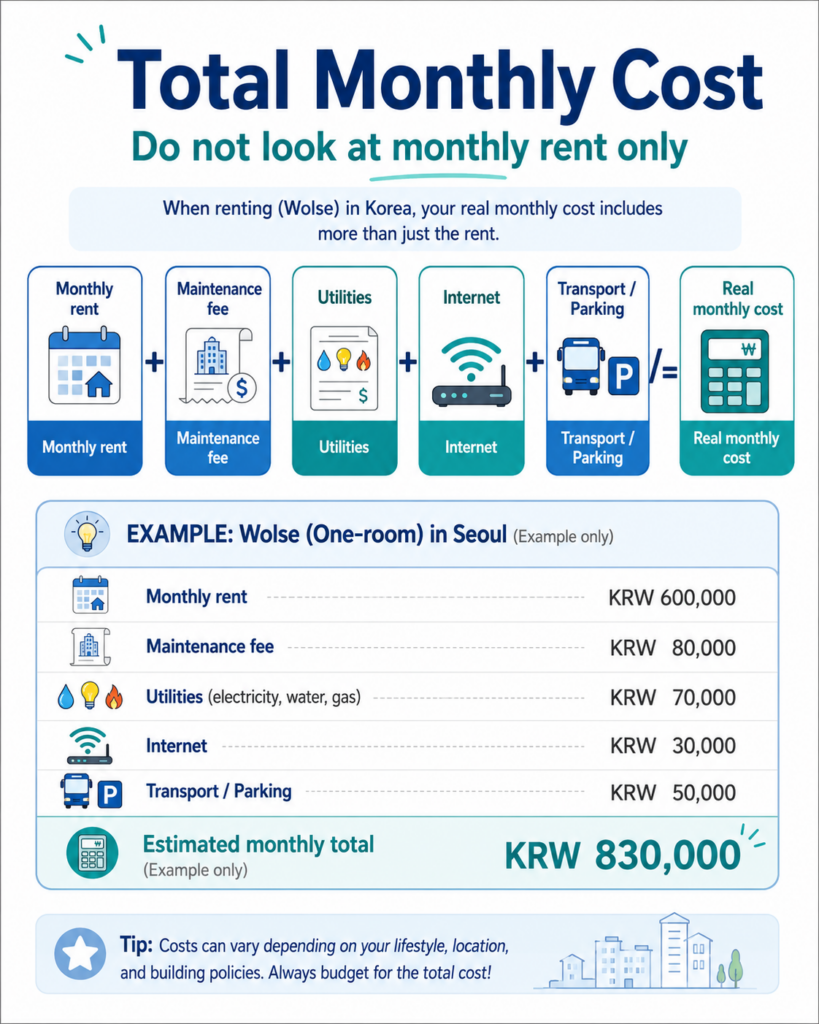
Wolse real monthly cost
Monthly rent
- Maintenance fee
- Utilities not included
- Internet if separate
- Transportation cost
- Possible parking fee
Example:
Monthly rent: KRW 600,000
Maintenance fee: KRW 80,000
Gas and electricity: KRW 70,000
Internet: KRW 30,000
Estimated monthly cost: KRW 780,000
Jeonse real cost
Jeonse may have no monthly rent, but it is not free.
You should consider:
Opportunity cost of deposit
Loan interest if borrowed
Maintenance fee
Utilities
Insurance or guarantee-related cost if used
Risk of delayed deposit return
If you borrow money for jeonse, monthly loan interest may become your real monthly housing cost.
Banjeonse real cost
Banjeonse has both deposit and monthly rent.
You should calculate:
Deposit
Monthly rent
Maintenance fee
Utilities
Loan interest if deposit is borrowed
Risk level based on deposit amount
The more deposit you pay, the more you should care about safety.
Deposit Risk: The Most Important Warning
The biggest risk in Korean housing is often the deposit.
This is especially true for jeonse and high-deposit banjeonse.
Before paying a large deposit, be careful.
If you are paying a large deposit, it is worth understanding the basic tenant protection rules under Korea’s housing lease law.
Ask questions like:
Is the landlord the real owner?
Is there debt on the property?
Is the deposit amount reasonable for the area?
Can I get a fixed date?
Should the lease contract be reported?
Can I report my move-in or address change?
Is the bank account name the same as the landlord?
What happens if the landlord cannot return the deposit?
If you are not sure, get help from someone who understands Korean rental contracts.
Do not rush because someone says the room will disappear soon.
A rushed deposit payment can become an expensive mistake.
Fixed Date and Lease Reporting
Two important words often appear in Korean rental contracts:
Fixed date
Lease contract reporting
A fixed date can help prove when your lease contract existed.
Housing lease contract reporting may also be required for certain contracts.
Some housing lease contracts must be reported within 30 days from the signing date if they meet certain conditions.
According to Seoul Foreign Portal guidance, the reporting system can apply to residential housing lease contracts signed on or after June 2021, in covered areas, when the security deposit exceeds KRW 60 million or monthly rent exceeds KRW 300,000.
The same guidance explains that filing the lease report can officially prove the lease relationship and that a fixed date is issued automatically when the report is filed.
Ask your real estate agent or local community service center:
이 임대차계약은 전월세 신고 대상인가요?
Meaning:
Is this lease contract subject to housing lease contract reporting?
Also ask:
확정일자를 받을 수 있나요?
Meaning:
Can I get a fixed date?
Maintenance Fee: Do Not Ignore It
Maintenance fee is called 관리비 in Korean.
It can change the real cost of the home.
A listing may show low monthly rent, but the maintenance fee may be high.
Ask what is included.
Possible included items:
Water
Internet
Building cleaning
Elevator
Security
Shared electricity
Trash-related fee
Management office fee
Possible separate items:
Electricity
Gas
Heating
Hot water
Internet
Parking
TV fee
Useful Korean sentence:
관리비에 포함된 항목과 별도 납부 항목을 알려주세요.
Meaning:
Please tell me what is included in the maintenance fee and what must be paid separately.
Brokerage Fee
If you use a real estate agent, you may need to pay a brokerage fee.
This is called 중개보수 in Korean.
Brokerage fees in Korea are not random. They are calculated based on transaction type and transaction amount, within official maximum rates.
For monthly rent, Seoul’s brokerage fee guide explains that transaction amount is generally calculated as deposit plus monthly rent multiplied by 100. However, if the transaction amount is under KRW 50 million, a different formula may apply.
Before signing, ask:
중개보수는 얼마인가요?
Meaning:
How much is the brokerage fee?
Also ask for a receipt:
영수증 받을 수 있나요?
Meaning:
Can I get a receipt?
What Foreigners Should Check Before Choosing Jeonse
If you are considering jeonse, do not decide only because there is no monthly rent.
Check these points first.
Property and landlord
Ask whether the landlord information matches the contract.
Check whether the payment account belongs to the correct person.
Deposit protection
Ask how your deposit will be protected.
Ask whether you can get a fixed date and complete the required reporting steps.
Building risk
Be careful with buildings where the total deposits may be high compared to the property value.
This is difficult for foreigners to judge alone, so get local help.
Contract period
Jeonse contracts are often long-term.
Make sure your visa, job, school, and family plans match the lease period.
Exit plan
Ask what happens if you need to move out early.
Do not assume you can leave easily before the contract ends.
Deposit return problem
If the landlord delays returning the deposit, you may need to check the official housing lease deposit refund process.
This is not something you want to learn only after the contract ends. If the deposit is large, understand the risk before signing.
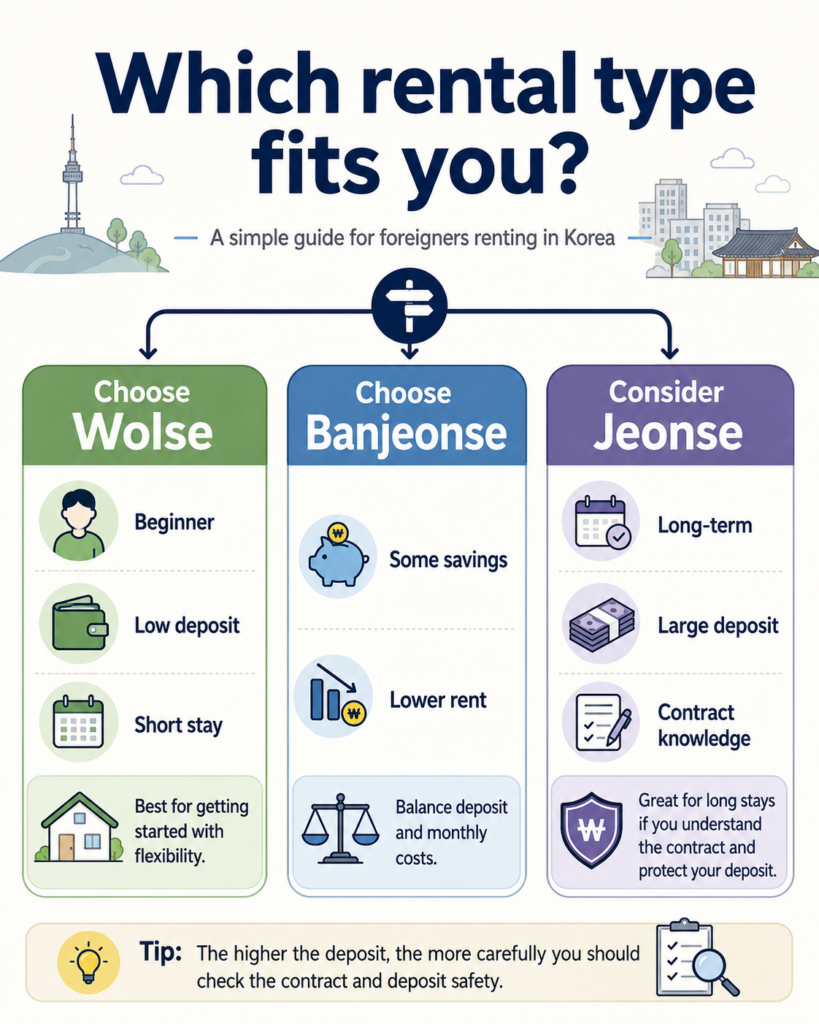
Practical Choice Guide
Choose wolse if:
You are new to Korea.
You do not have a large deposit.
You want a simpler rental structure.
You may move again soon.
You are a student or working holiday maker.
You prefer lower upfront risk.
Choose banjeonse if:
You have some savings.
You want lower monthly rent.
You understand that the deposit is larger than normal wolse.
You can check the contract properly.
You are staying longer than a short visit.
Consider jeonse only if:
You are staying long-term.
You understand Korean rental contracts.
You can verify deposit safety.
You can get professional or trusted help.
You know how fixed date and lease reporting work.
You have a clear plan for deposit return.
Common Mistakes to Avoid
Comparing only monthly rent
A room with low rent may have a high maintenance fee, high deposit, or bad transportation cost.
Choosing jeonse without understanding deposit risk
No monthly rent does not mean no risk.
The deposit is the main issue.
Not asking about maintenance fee
Always ask what is included and what is separate.
Not checking lease reporting
Some contracts must be reported within 30 days.
Ask whether your contract is subject to reporting.
Not getting payment records
Use bank transfer when possible.
Keep receipts and screenshots.
Not checking the landlord account
Ask why if the payment account name is different from the landlord name.
Not planning address change reporting
After moving, you may need to update your address if you are a registered foreign resident.
Read this guide if you moved: Report Address Change in Korea as a Foreigner.
Rushing because of pressure
Do not pay a large deposit too quickly.
Take time to check.
Useful Korean Sentences
To ask whether it is wolse or jeonse
이 계약은 월세인가요, 전세인가요?
Is this contract wolse or jeonse?
To ask about banjeonse
이건 반전세인가요?
Is this banjeonse?
To ask the deposit
보증금은 얼마인가요?
How much is the deposit?
To ask monthly rent
월세는 얼마인가요?
How much is the monthly rent?
To ask maintenance fee
관리비는 얼마이고, 어떤 항목이 포함되어 있나요?
How much is the maintenance fee, and what is included?
To ask about fixed date
확정일자를 받을 수 있나요?
Can I get a fixed date?
To ask about lease report
이 임대차계약은 전월세 신고 대상인가요?
Is this lease contract subject to housing lease contract reporting?
To ask deposit return timing
계약 종료 후 보증금은 언제 반환되나요?
When will the deposit be returned after the contract ends?
To ask about early termination
계약 기간 중간에 나가야 하면 어떻게 되나요?
What happens if I need to move out before the contract ends?
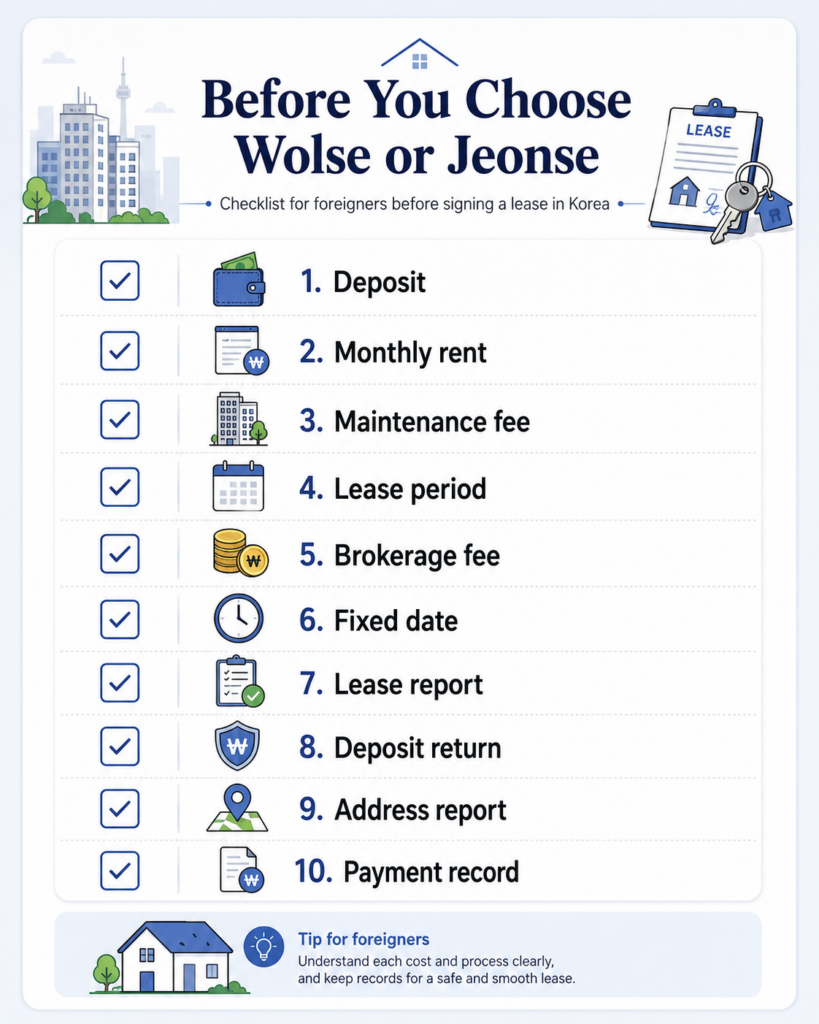
Checklist Before Choosing Wolse or Jeonse
Before deciding, check this list.
You know whether the contract is wolse, jeonse, or banjeonse.
You checked the deposit.
You checked monthly rent.
You checked maintenance fee.
You asked what utilities are separate.
You checked brokerage fee.
You checked the lease period.
You checked early termination rules.
You checked deposit return timing.
You checked landlord and payment account.
You asked about fixed date.
You asked whether lease reporting is required.
You considered deposit risk.
You checked whether the address can be used for Residence Card address reporting.
You kept all payment records.
FAQ
What is wolse in Korea?
Wolse is monthly rent. You usually pay a deposit first and then pay rent every month.
What is jeonse in Korea?
Jeonse is a deposit-based lease system. You usually pay a large deposit and do not pay monthly rent during the lease period.
What is banjeonse?
Banjeonse is a mixed rental type between wolse and jeonse. It usually has a higher deposit than normal wolse and lower monthly rent.
Which is better for foreigners, wolse or jeonse?
For many foreigners new to Korea, wolse is usually easier because the deposit is smaller and the structure is simpler. Jeonse may work for long-term residents who understand deposit protection and contract risks.
Is jeonse dangerous?
Jeonse is not automatically dangerous, but the deposit can be very large. The risk is mainly about whether the landlord can return the deposit at the end of the contract.
Can foreigners sign a jeonse contract?
Yes, foreigners may be able to sign a jeonse contract. However, they should be careful and understand deposit protection, fixed date, contract reporting, and landlord/property risk.
What is a maintenance fee?
Maintenance fee is a monthly management-related cost. It may include some utilities or building services, but the included items vary by property.
Do I need to report a wolse or jeonse contract?
Some housing lease contracts must be reported within 30 days if they meet the reporting conditions. Ask your agent or local office whether your contract is subject to reporting.
Should I use a real estate agent?
A licensed real estate agent can help, especially if you do not speak Korean. But you should still check the contract, fee, landlord information, payment records, and deposit risk.
What should I choose if I am new to Korea?
If you are new to Korea, wolse is usually the most practical starting option. You can consider banjeonse or jeonse later after you understand the housing system better.
Final Thoughts
Wolse vs Jeonse for foreigners is not just a vocabulary lesson.
It is one of the most important decisions you will make before renting in Korea.
Wolse is usually easier for beginners because the deposit is smaller and the structure is closer to monthly rent in other countries.
Jeonse can reduce monthly rent, but it requires a much larger deposit and much more careful checking.
Banjeonse can be a middle option, but the deposit still matters.
The safest way to compare housing is not to ask only, “How much is the rent?”
Ask:
How much is the deposit?
How much is the monthly rent?
What is included in the maintenance fee?
What is the contract period?
Can I get a fixed date?
Does the lease need to be reported?
When will the deposit be returned?
Is this realistic for my visa, job, school, and stay period?
If you are new to Korea, start simple.
Choose a contract you understand, keep the deposit manageable, save every payment record, and do not rush into a large deposit contract without help.
Understanding wolse, jeonse, and banjeonse can protect your money and make your housing life in Korea much smoother.