Korean Residence Card for foreigners is one of the most important documents you need if you plan to live in Korea long-term.
Many foreigners still call it an ARC, which means Alien Registration Card. However, the more current English term is Residence Card. You may still see both names online, at schools, in older documents, and even in daily conversation.
Your Korean Residence Card for foreigners is not just an immigration ID card. It can affect your bank account, Korean phone number, phone verification, housing contract, healthcare, visa extension, and many other parts of daily life in Korea.
If you are still setting up your Korean phone number, read this first: How to Get a Korean Phone Number as a Foreigner in 2026.
If your phone verification keeps failing, this guide will help: Korean Phone Verification for Foreigners: Why It Fails and How to Fix It.
If you are trying to open a Korean bank account, read this guide too: Open a Bank Account in Korea as a Foreigner.
Quick Answer
A Korean Residence Card for foreigners is the main ID card for many foreign residents staying in Korea long-term.
If you plan to stay in Korea for more than 90 days, you may need to register as a foreign resident and receive a Residence Card, depending on your visa status.
You usually apply through the immigration office that has jurisdiction over your place of stay. In many cases, you should prepare your passport, application form, photo, visa-related documents, proof of residence, and any documents required for your visa type.
Your Residence Card can affect:
Bank account opening
Phone number registration
Korean phone verification
PASS app setup
Housing contracts
Health insurance
Work or school administration
Visa extension
Address change reporting
Daily identity checks
The most important rule is simple.
Do not treat your visa as the final step. If you are staying long-term, the Korean Residence Card for foreigners is often the real starting point for daily life in Korea.
What Is a Korean Residence Card?
The Korean Residence Card is an official identification card issued to many foreign residents in Korea.
It was commonly known as the Alien Registration Card, or ARC. Many people still use the word ARC because it is familiar. But in newer English guidance, you may see the term Residence Card.
The card usually contains information such as:
Your name
Nationality
Date of birth
Residence status
Registration number
Issue date
Expiry date
Residence-related information
Immigration-related information
For foreigners, this card often becomes the main ID used in daily life.
You may need it when dealing with banks, mobile carriers, government offices, schools, employers, landlords, hospitals, and other services.
In simple words, the Korean Residence Card for foreigners is the document that connects your legal stay in Korea with real daily services.
ARC vs Residence Card: Are They the Same?
In everyday conversation, yes, many people use ARC and Residence Card to mean the same thing.
ARC means Alien Registration Card. Residence Card is the newer and more natural English term.
So if someone says:
ARC
Alien Registration Card
Foreigner Registration Card
Residence Card
Registration Card
They may be talking about the same or very similar foreign resident ID card.
For blog SEO and reader clarity, it is best to use both terms.
Example:
The Korean Residence Card, formerly known as the Alien Registration Card or ARC, is the main ID card for many long-term foreigners in Korea.
This helps readers who search for either the old name or the newer term.
Who Needs a Residence Card in Korea?
In general, foreigners who plan to stay in Korea for more than 90 days may need to register as foreign residents and receive a Residence Card.
This commonly includes:
Exchange students
Language students
University students
Workers
English teachers
Researchers
Working holiday makers
Marriage migrants
Long-term residents
Some business or investment visa holders
Some digital nomad or workation visa holders
Other long-term visa holders
Short-term tourists usually do not apply for a Residence Card because they are not staying as long-term registered residents.
However, exact requirements can depend on your visa type and status. Always check your visa conditions or ask the immigration office if you are unsure.
A Korean Residence Card for foreigners is especially important if you need to open a bank account, register a phone number under your name, rent housing, or use Korean identity verification.
When Should You Apply?
If you are required to register, do not wait until the last minute.
Many long-term foreigners need to register within 90 days of entering Korea.
This is one of the most important deadlines to remember.
If you miss the deadline, you may face problems with your stay status, paperwork, or possible penalties.
A practical timeline looks like this:
Arrive in Korea
Get temporary phone access if needed
Prepare housing address
Book an immigration office visit
Prepare documents
Visit immigration office
Submit application
Wait for card issuance
Pick up or receive the card
Use it for banking, phone registration, and daily life
The earlier you prepare, the better.
Immigration office appointments can become busy, especially before school semesters, visa deadlines, or popular intake periods.
Why the Residence Card Matters for Daily Life
Many foreigners think the Residence Card is only for immigration.
But in Korea, it affects much more than immigration.
You may need it for:
Opening a Korean bank account
Updating your mobile phone number registration
Using Korean phone verification
Setting up PASS
Signing a housing contract
Registering your address
Receiving salary
Using some government services
Getting health insurance
Confirming your identity at hospitals
Applying for visa extension
Reporting changes in residence
Handling school or employer documents
This is why the Korean Residence Card for foreigners should be treated as part of your full Korea life setup.
The best order is often:
Residence Card
→ Phone number under your legal name
→ Bank account
→ Mobile banking
→ Korean apps
→ Housing and healthcare setup
If one part does not match, other systems may fail.
Documents You May Need
Required documents can vary depending on your visa type, nationality, school, employer, and local immigration office.
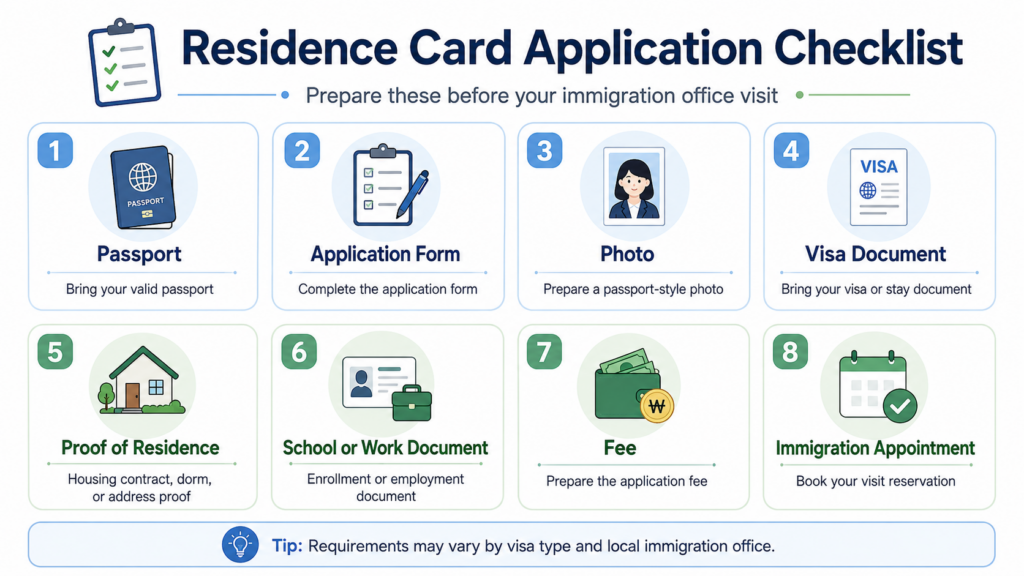
Still, many applicants should prepare the following:
Passport
Application form
Passport-style photo
Visa or visa confirmation document
Proof of residence in Korea
Application fee or payment method
School document, if you are a student
Employment document, if you are working
Business-related document, if relevant
Other documents requested for your visa type
Proof of residence can be especially important.
Depending on your situation, this may include:
Housing contract
Dormitory confirmation
Confirmation of residence or accommodation
Document from your landlord
Document from your school or employer
Other address-related proof accepted by immigration
Do not assume every applicant needs exactly the same documents.
A student and a worker may be asked for different supporting documents.
How to Apply for a Korean Residence Card
The exact process can vary, but the general flow is usually simple.
Step 01) Check whether you need to register
First, confirm whether your visa type requires foreign resident registration.
If you are staying more than 90 days, you should check carefully.
If you are a student, your school may provide instructions.
If you are an employee, your employer may help with some documents.
If you are unsure, contact immigration or call 1345.
Step 02) Find your immigration office
You usually need to visit the immigration office that has jurisdiction over your place of stay.
This means your office is based on your Korean address, not just your preference.
Do not randomly choose any immigration office.
Check your address and confirm which office handles your area.
Step 03) Make a visit reservation
Many immigration services use online visit reservations.
HiKorea is the main portal foreigners use for immigration-related services, visit reservations, and some online applications.
You may need your passport information or existing registration information to make a reservation.
If you are applying for the first time, use the option that matches your situation.
Some immigration services are available online through HiKorea, but first-time card issuance or reissuance may still require office procedures.
Step 04) Prepare your documents
Prepare all required documents before your appointment.
Make printed copies if needed.
Bring the original documents as well.
It is better to bring extra documents than to be asked to return another day.
Step 05) Visit the immigration office
Go to the immigration office on your reserved date.
Arrive early.
Bring your reservation confirmation, passport, documents, photo, and fee or payment method.
At the office, submit your application and follow the staff instructions.
Step 06) Submit fingerprints if required
Some applicants may need to provide fingerprints or additional information during the process.
Follow the instructions given by the immigration officer.
Step 07) Wait for card issuance
After submitting your application, the card may take several weeks to be issued.
The exact processing time can vary depending on office workload, visa type, season, and document status.
Do not plan important banking or phone verification tasks too tightly around the expected date.
Step 08) Pick up or receive your card
Depending on the option available, you may pick up the card in person or receive it by registered mail.
Once you receive it, check your information carefully.
Make sure your name, nationality, status, and expiry date look correct.
What to Check After Receiving Your Card
After receiving your Residence Card, do not just put it away.
Check the information carefully.
Look at:
Your English name
Nationality
Date of birth
Residence status
Card expiry date
Registration number
Address-related information
Any spelling or formatting issue
If your name format is different from your passport or bank records, it may affect phone verification, bank apps, and other services later.
Foreign names can be stored differently across systems.
For example:
JOHN MICHAEL SMITH
SMITH JOHN MICHAEL
JOHN SMITH
JOHN M SMITH
Small differences can matter in Korean digital systems.
If you see a serious mistake, contact immigration or ask for guidance as soon as possible.
How the Residence Card Connects to Phone Verification
Your Residence Card can affect your Korean phone number and phone verification.
Many foreigners first buy a temporary SIM using only a passport.
That may be enough for internet, calls, and SMS.
But for long-term identity verification, you may need to update your mobile carrier information using your Residence Card.
This can help with:
PASS app
Korean mobile verification
Banking app login
Online shopping verification
Mobile certificates
Government services
Age verification
Payment services
If your phone verification fails even after getting your Residence Card, the issue may be that your mobile carrier has not updated your identity information.
A useful Korean sentence is:
외국인등록증 정보로 휴대폰 본인확인 정보를 업데이트하고 싶습니다.
Meaning:
I would like to update my phone verification information using my Residence Card.
For more details, read: Korean Phone Verification for Foreigners: Why It Fails and How to Fix It.
How the Residence Card Connects to Banking
Banks often ask for your Residence Card when opening or updating a Korean bank account.
Your Residence Card helps banks confirm your identity, stay status, and local information.
You may need it for:
Opening a bank account
Updating bank customer information
Setting up mobile banking
Receiving a check card
Registering overseas remittance
Increasing transaction limits
Verifying your identity for financial services
If you opened a bank account before receiving your Residence Card, you may need to visit the bank again later to update your information.
From 2025, some banks started accepting mobile foreigner residence cards for bank account opening and financial transactions.
This is one reason why the Residence Card, phone number, and bank account should be planned together.
For more details, read: Open a Bank Account in Korea as a Foreigner.
How the Residence Card Connects to Housing
Your Residence Card can also matter when renting housing.
Landlords, real estate agents, and institutions may ask for your ID information when preparing documents or confirming your identity.
You may need your Korean address for your Residence Card application, and you may later need to report address changes when you move.
This creates a loop:
You need an address to apply for Residence Card.
You need a Residence Card for many long-term services.
If you move, you must update your address properly.
Because of this, keep your housing documents organized.
Useful documents may include:
Lease contract
Dormitory confirmation
Accommodation confirmation
Landlord confirmation
Address confirmation document
Future internal link to add after publishing:
How to Rent an Apartment in Korea as a Foreigner
Address Change: Do Not Ignore This
After you receive your Residence Card, your address matters.
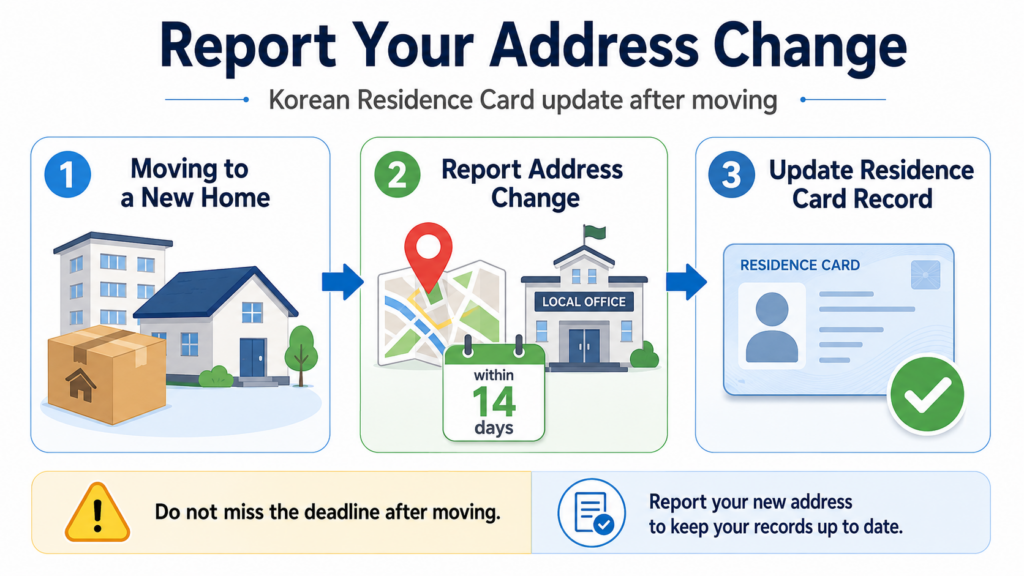
If you move to a new place, you may need to report your change of residence within the required period.
Many public service pages explain that registered foreigners must report a change of residence within 14 days of moving.
You may be able to report it at a local community center, district office, immigration office, or through an available online process, depending on your situation.
Do not ignore this.
Failing to report your address change can cause problems later with immigration, visa extension, official notices, or penalties.
What Is the Mobile Residence Card?
Korea introduced a Mobile Residence Card for registered foreign residents in 2025.
This means some registered foreign residents can use a mobile version of their Residence Card through a smartphone-based identity system.
The mobile card can make identity confirmation more convenient, especially as Korean services become more digital.
However, if you are opening your first bank account, applying for important immigration tasks, or visiting an office for the first time, it is still safer to bring your physical Residence Card and passport.
The mobile version is useful, but do not assume every service, branch, or office will handle it the same way.
For important tasks, bring both if possible.
Physical Residence Card
Passport
Mobile Residence Card, if available
What If You Lose Your Residence Card?
If you lose your Residence Card, take action quickly.
You may need to report the loss and apply for reissuance.
Do not ignore it, because your Residence Card is your main foreign resident ID in Korea.
A lost card can affect banking, phone verification, housing, immigration tasks, and identity checks.
You should check the current reissuance process through HiKorea or ask immigration for instructions.
Useful Korean sentence:
외국인등록증을 분실했습니다. 재발급 절차를 알고 싶습니다.
Meaning:
I lost my Residence Card. I would like to know the reissuance process.
Useful Korean Sentences at Immigration Office
To say you want to apply
외국인등록증을 신청하고 싶습니다.
I would like to apply for a Residence Card.
To ask about required documents
외국인등록증 신청에 필요한 서류가 무엇인가요?
What documents are required to apply for a Residence Card?
To ask about your jurisdiction office
제 주소지 관할 출입국사무소가 어디인가요?
Which immigration office has jurisdiction over my address?
To ask about appointment reservation
방문예약을 해야 하나요?
Do I need to make a visit reservation?
To ask about processing time
발급까지 얼마나 걸리나요?
How long does it take to be issued?
To ask about address change
이사를 했는데 체류지 변경 신고를 하고 싶습니다.
I moved and would like to report my change of residence.
To ask about updating information
등록증 정보가 잘못된 것 같습니다. 확인 부탁드립니다.
I think the information on my Residence Card may be incorrect. Please check it.
Common Mistakes to Avoid
Do not wait until the 90-day deadline is almost over.
Do not assume your visa alone is enough for daily life setup.
Do not forget to make a visit reservation.
Do not visit the wrong immigration office.
Do not bring only digital copies of important documents.
Do not forget your proof of residence.
Do not ignore your name format.
Do not forget to check the card information after receiving it.
Do not forget to report your address change after moving.
Do not assume the Mobile Residence Card works everywhere.
Do not lose your physical card.
Do not use outdated ARC information without checking current guidance.
Practical Checklist Before You Apply
Before applying for your Korean Residence Card for foreigners, check this list.
You know whether your visa requires registration.
You know your 90-day deadline.
You have your passport.
You have your visa-related document.
You have a passport-style photo.
You have proof of residence.
You have school or employment documents if needed.
You know your immigration office jurisdiction.
You made a visit reservation if required.
You prepared the application fee or payment method.
You printed copies of important documents.
You checked your name spelling carefully.
FAQ
Is the Korean Residence Card the same as ARC?
In many cases, yes. ARC means Alien Registration Card, and many foreigners still use that term. Residence Card is the newer English term often used for the same foreign resident ID card.
Who needs a Korean Residence Card for foreigners?
Foreigners staying in Korea for more than 90 days often need to register and receive a Residence Card, depending on visa type and status. Short-term tourists usually do not apply for one.
When should I apply for a Residence Card?
If you are required to register, you generally should apply within 90 days of entering Korea. Do not wait until the last minute because immigration appointments can be busy.
Can I apply online?
Some immigration services are available online through HiKorea, but first-time card issuance or reissuance may still require office procedures. Always check the current HiKorea guidance for your exact situation.
What documents do I need?
Common documents include passport, application form, photo, visa-related document, proof of residence, and school or employment documents if applicable. Requirements vary by visa type.
Can I open a bank account without a Residence Card?
It may be possible in some limited situations, but a Residence Card usually makes long-term banking much easier and more stable.
Does the Residence Card help with phone verification?
Yes, it can. If your phone number was opened with a passport first, you may need to update your carrier information with your Residence Card to improve identity verification.
Do I need to report address changes?
Yes, registered foreigners generally need to report a change of residence within the required period after moving. Many public service guides mention 14 days.
What is the Mobile Residence Card?
The Mobile Residence Card is a smartphone-based version of the Residence Card introduced for registered foreign residents. It can support digital identity use, but you should still keep your physical card safe.
What should I do if I lose my Residence Card?
Report the loss and check the reissuance process through HiKorea or immigration. Do not delay because the card is important for identity checks and daily life services.
Final Thoughts
Korean Residence Card for foreigners is one of the most important foundations for long-term life in Korea.
It is not just an immigration card.
It connects to your phone number, bank account, housing, healthcare, school, work, government services, and online identity verification.
If you are planning to stay in Korea long-term, do not treat the Residence Card as a small administrative task. Treat it as the foundation of your Korean life setup.
Once your Residence Card, phone number, bank account, and address information are properly connected, daily life becomes much easier.
You can verify your identity, open accounts, use apps, sign contracts, receive services, and manage your stay with fewer problems.
For long-term foreigners in Korea, the Residence Card is not just an ID.
It is the key to living in Korea more smoothly.