
Opening a bank account is one of the most important steps for foreigners living in Korea.
You may need a Korean bank account to receive salary, pay rent, use Korean apps, make local transfers, get a debit card, connect mobile banking, and manage daily life more easily.
But many foreigners get confused because the process is not always the same for everyone. A student, employee, working holiday maker, short-term visitor, and long-term resident may be asked for different documents.
In many cases, the key documents are your passport, Residence Card, Korean phone number, and documents showing why you need the account.
If you are still setting up your Korean phone number, start with this guide first: How to Get a Korean Phone Number as a Foreigner in 2026.
If your banking app fails during phone verification, read this guide too: Korean Phone Verification for Foreigners: Why It Fails and How to Fix It.
Quick Answer
Yes, foreigners can open a bank account in Korea.
However, the exact process depends on your visa status, documents, bank branch, and purpose of financial transaction.
In most cases, you should prepare:
Passport
Residence Card
Korean phone number
Korean address
Proof of purpose for the account
Employment or school document if applicable
Income or salary document if applicable
Some banks may allow basic account opening with a passport, but a Residence Card usually makes the process easier and more stable for long-term banking.
If you cannot prove the purpose of the account, the bank may open a limited account with lower withdrawal or transfer limits.
Why a Korean Bank Account Matters
A Korean bank account is not just for saving money.
It is connected to many parts of daily life in Korea.
You may need it for:
Receiving salary
Paying rent or maintenance fees
Using Korean mobile banking
Getting a debit card or check card
Making bank transfers
Paying phone bills
Connecting Korean payment apps
Shopping online
Receiving refunds
Sending money overseas
Proving financial activity in Korea
For long-term residents, a Korean bank account becomes part of your life setup, just like your phone number and Residence Card.
That is why opening a bank account should come soon after getting your Residence Card and Korean phone number.
Can Tourists Open a Bank Account in Korea?
For short-term tourists, opening a regular Korean bank account is usually difficult.
A tourist may be able to exchange money or use a foreign card, but regular Korean bank accounts are generally designed for people who have a clear reason to conduct financial transactions in Korea.
If you are only visiting Korea for travel, it is usually easier to use:
International credit card
International debit card
Travel card
Currency exchange
ATM cash withdrawal
Mobile travel payment tools
If you are staying longer as a student, worker, spouse, working holiday maker, or resident, opening a Korean bank account becomes much more realistic.
Do You Need a Residence Card?
For long-term foreigners, a Residence Card is one of the most important documents for opening a bank account.
The Working Holiday Info Center explains that a Residence Card is required for many activities in Korea, including opening a bank account, purchasing a mobile phone, signing a lease, and working legally.
This is why foreigners usually follow this order:
Arrive in Korea
Get a temporary phone number
Apply for Residence Card
Open a Korean bank account
Set up mobile banking
Connect a verified phone number
Use Korean apps more smoothly
A passport is important, but for long-term banking, your Residence Card often becomes the main identity document.
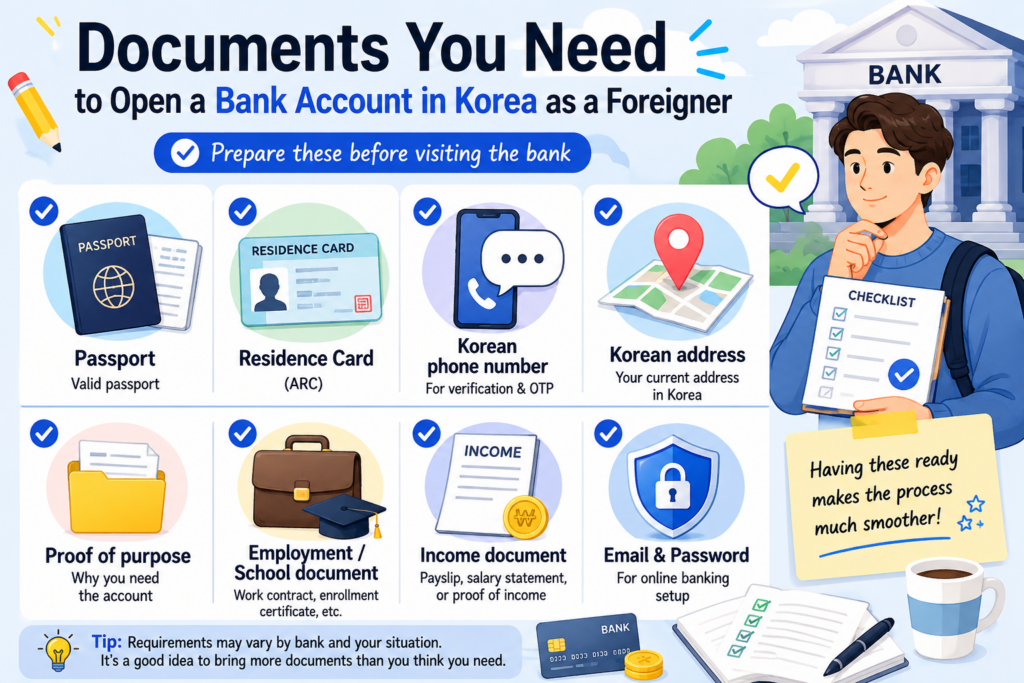
Documents You May Need
Document requirements can vary by bank, branch, account type, and your personal situation.
In general, prepare these documents before visiting a bank.
Basic documents
Passport
Residence Card
Korean phone number
Korean address
Email address
Local contact information
Proof of purpose documents
The bank may ask why you need the account.
Examples include:
Certificate of employment
Employment contract
Payslip
Salary income withholding receipt
Certificate of student enrollment
School admission document
Business-related contract
Part-time work agreement
Proof of income
Housing contract
Other documents showing the purpose of the account
This is important because Korean banks may limit accounts when the purpose of the transaction is not clear.
Tax and residency-related information
Depending on your situation, the bank may ask for tax-related information, overseas address, overseas contact number, or foreign taxpayer identification number.
This does not mean something is wrong. It is part of financial reporting and compliance.
Why Banks Ask for the Purpose of the Account
Foreigners often feel surprised when a bank asks:
Why do you need this account?
But this question is normal.
Banks need to understand the purpose of the financial transaction. If you cannot submit documents proving the purpose, the bank may still open an account, but it may be a limited account.
A limited account may have lower withdrawal limits or lower transfer limits.
For example, if you are opening an account to receive salary, bring documents related to your employment.
If you are opening an account as a student, bring your enrollment certificate or school document.
If you are opening an account for business income, bring documents that show the business purpose.
The more clearly you can show your reason, the smoother the process can be.
Best Time to Open a Bank Account
The best time to open a Korean bank account is after you have:
Residence Card
Korean address
Korean phone number
Clear purpose for the account
Supporting documents
If you open the account too early with only a passport, you may need to visit the bank again later after receiving your Residence Card.
Some banks specifically say that if you opened an account with a passport and later received your Residence Card, you should bring both your passport and Residence Card when visiting the bank to update information.
So if you are staying long-term, it may be better to wait until your Residence Card is ready unless you urgently need an account.
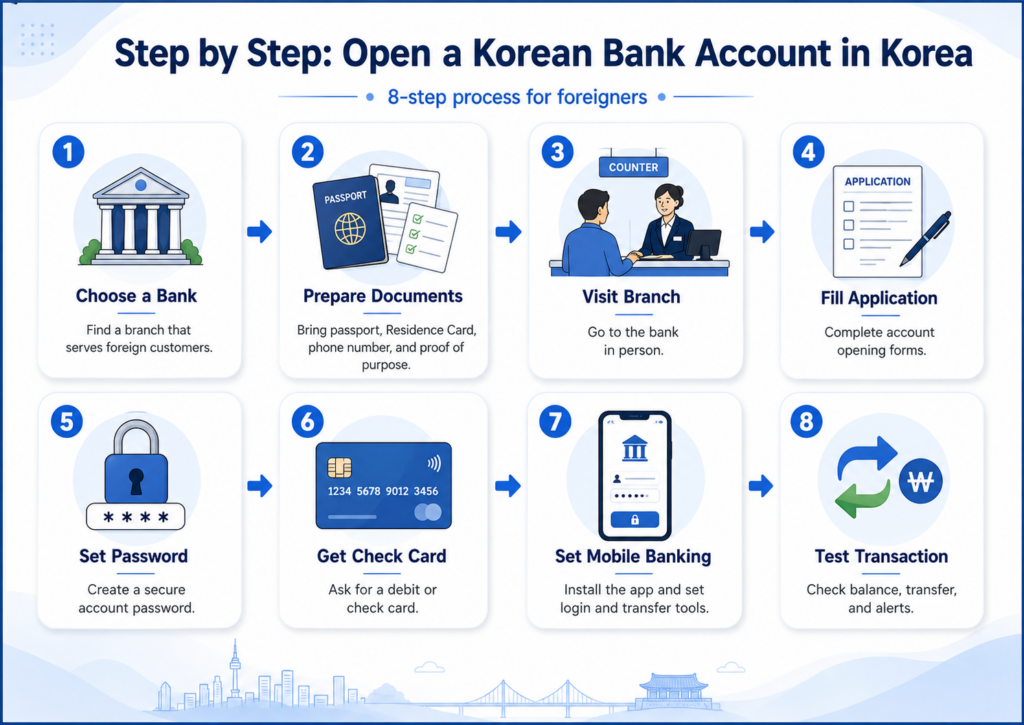
Step-by-Step: How to Open a Bank Account in Korea
Step 01) Choose a bank
Common banks used by foreigners include:
Woori Bank
Hana Bank
Shinhan Bank
KB Kookmin Bank
IBK Industrial Bank of Korea
NH NongHyup Bank
Some branches are more familiar with foreign customers than others.
Branches near universities, foreigner-heavy areas, business districts, and immigration-related neighborhoods may be more comfortable handling foreign documents.
Step 02) Prepare your documents
Before visiting, prepare your passport, Residence Card, Korean phone number, Korean address, and proof of purpose.
If you are a student, bring your school document.
If you are employed, bring your employment contract or certificate of employment.
If you are receiving salary, ask your employer what document the bank usually accepts.
Step 03) Visit the branch
Most foreigners still open their first Korean bank account by visiting a branch.
At the bank, you may need to take a waiting number and tell the staff that you want to open a bank account.
Useful sentence:
I would like to open a bank account.
In Korean:
은행 계좌를 개설하고 싶습니다.
Step 04) Fill out the application
The bank may ask you to fill in forms with your:
Name
Date of birth
Nationality
Address in Korea
Phone number
Email
Occupation
Purpose of transaction
Source of funds
Tax residency information
Make sure your name matches your Residence Card and phone number records as closely as possible.
Step 05) Set your password and security method
You may need to create a bank account password.
Avoid using simple numbers such as your birth date, phone number, 1234, or 0000.
The bank may also issue or register a security card, OTP, digital certificate, or mobile authentication method for internet and mobile banking.
Step 06) Ask for a debit card or check card
In Korea, many people use a check card, which is similar to a debit card. It deducts money directly from your bank account.
Ask whether you can receive a check card when opening the account.
Useful sentence:
Can I also get a debit card or check card?
In Korean:
체크카드도 같이 발급받을 수 있나요?
Step 07) Set up internet and mobile banking
Do not leave the branch without asking about mobile banking.
Ask the staff to help you set up:
Mobile banking app
Internet banking
Transfer limit
Login method
Certificate or OTP
English app availability
Overseas remittance service if needed
This is very important because some foreigners open a bank account but later cannot use online transfers properly.
Step 08) Test a small transaction
After opening the account, test a small transaction.
Check:
Can you log in to the app?
Can you see your balance?
Can you receive money?
Can you transfer money?
Can you use your card?
Can you receive SMS or app notifications?
If something does not work, fix it early before you need the account urgently.
Can You Open a Bank Account by Mobile App?
Some banks may allow account opening through a mobile app, depending on the bank and your identity verification status.
However, for many foreigners, the first account is easier at a physical branch.
Mobile app account opening can fail if:
Your phone verification does not work
Your name does not match the carrier record
Your Residence Card cannot be verified
Your Korean address is not accepted
Your foreign ID format causes an error
You cannot complete digital certificate setup
If your mobile banking app fails, do not assume you are not eligible. Visit a branch with your documents.
This is why phone verification matters before banking.
If you have not fixed your phone verification yet, read: Korean Phone Verification for Foreigners: Why It Fails and How to Fix It.
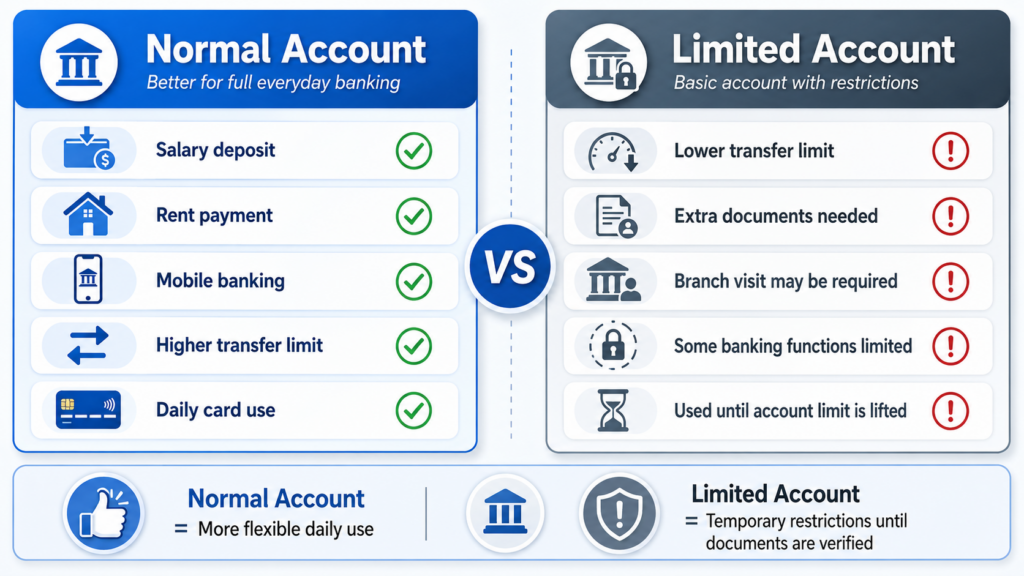
What Is a Limited Account?
A limited account is a bank account with restrictions.
This can happen when the bank cannot clearly verify your transaction purpose or supporting documents.
A limited account may still let you receive money and use basic services, but it may have lower limits for withdrawals or transfers.
This can be frustrating if you need to pay rent, send tuition, receive salary, or transfer larger amounts.
How to reduce the chance of a limited account
Bring proof of employment or school enrollment.
Bring documents showing why you need the account.
Use a branch familiar with foreign customers.
Make sure your Residence Card and phone number are ready.
Explain your purpose clearly.
Ask what document is needed to remove the limit.
Useful Korean sentence:
거래한도 제한 계좌가 아닌 일반 계좌로 개설하려면 어떤 서류가 필요한가요?
Meaning:
What documents do I need to open a regular account instead of a limited transaction account?
Debit Card, Check Card, and Credit Card
In Korea, foreigners often start with a check card.
A check card works like a debit card. The payment is taken directly from your bank account.
This is usually easier to get than a credit card.
A credit card can be more difficult because card companies may review your residency status, employment, assets, and financial transaction history in Korea.
If you are new to Korea, it may be better to start with a check card first.
Ask the bank:
Can I get a check card today?
In Korean:
오늘 체크카드 발급이 가능한가요?
Also ask whether the card can be used for:
Online payments
Transportation card function
International payments
ATM withdrawals
Mobile wallet registration
Why Your Korean Phone Number Matters for Banking
Your Korean phone number is very important for banking.
Banks may use your phone number for:
Account opening
Mobile banking setup
SMS alerts
Transfer confirmation
Security authentication
App login
Identity verification
Card notification
Fraud prevention
If your phone number is not under your own name, or your phone verification fails, banking apps may not work properly.
This is why the best setup is:
Residence Card
→ Korean phone number under your name
→ Bank account
→ Mobile banking
→ Check card
→ Payment apps and shopping apps
If you do this in the wrong order, you may need to visit the bank or mobile carrier several times.
Common Reasons Foreigners Get Rejected or Delayed
Your Residence Card is not ready
Some banks may not open a full account without a Residence Card.
If you only have a passport, ask what type of account is possible and whether you need to return after receiving your Residence Card.
Your purpose is unclear
If the bank does not understand why you need the account, they may ask for more documents or open a limited account.
Your documents do not match
Your passport name, Residence Card name, phone carrier name, and bank application name should match as closely as possible.
Even small differences can cause problems later with mobile banking and phone verification.
Your phone number is not verified
If your Korean phone number is not under your own name, mobile banking setup may be harder.
The branch is not used to foreign customers
Sometimes the problem is not the bank itself but the specific branch.
If one branch is not helpful, try a larger branch, a university-area branch, or a branch known for foreign customer service.
You do not have enough supporting documents
Bring more documents than you think you need.
It is better to bring extra documents and not use them than to visit the bank twice.
Useful Korean Sentences at the Bank
To open an account
은행 계좌를 개설하고 싶습니다.
I would like to open a bank account.
To explain you are a foreign resident
저는 한국에 거주하는 외국인입니다.
I am a foreign resident living in Korea.
To ask about required documents
계좌 개설에 필요한 서류가 무엇인가요?
What documents are required to open an account?
To ask about a limited account
거래한도 제한 계좌인가요?
Is this a limited transaction account?
To ask how to remove limits
한도 제한을 해제하려면 어떤 서류가 필요한가요?
What documents do I need to remove the transaction limit?
To ask for a check card
체크카드도 같이 발급받을 수 있나요?
Can I also get a check card?
To ask for mobile banking
모바일뱅킹도 사용할 수 있게 설정해 주세요.
Please help me set up mobile banking.
To ask about English service
영어 가능한 직원이나 외국인 전용 상담이 있나요?
Is there an English-speaking staff member or foreign customer service?
To ask about overseas remittance
해외송금 서비스도 신청할 수 있나요?
Can I also apply for overseas remittance service?
Bank Hours in Korea
Bank branch hours in Korea are usually on weekdays during business hours.
A common schedule is Monday to Friday, around 9:00 AM to 4:00 PM.
However, branch hours can vary, and some foreigner-specialized branches or special service branches may operate differently.
Before visiting, check the branch hours online or call the bank.
If you need English support, ask whether the branch has foreign language service before going.
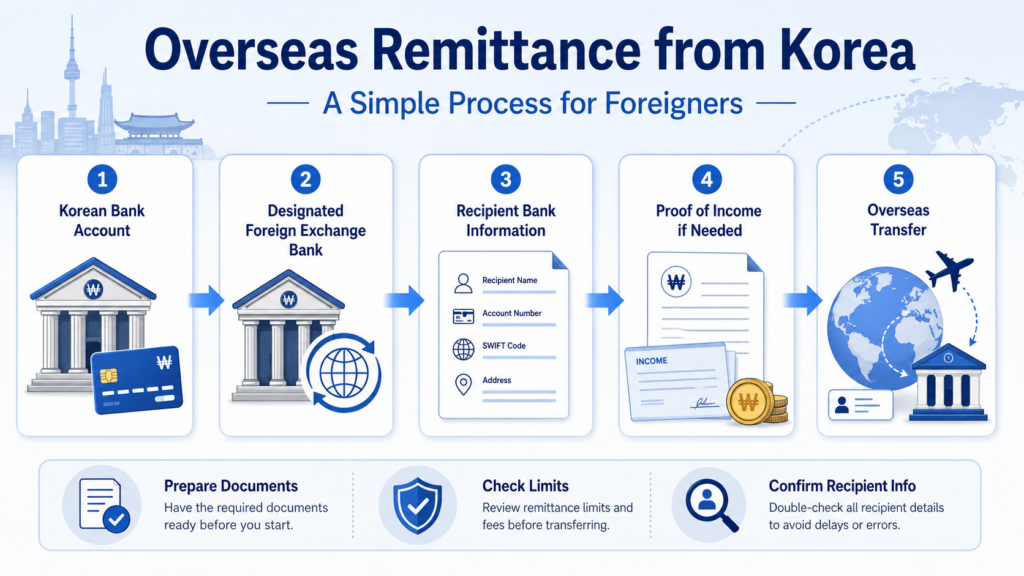
Overseas Remittance from Korea
Many foreigners open a Korean bank account because they need to send money home.
Overseas remittance can require additional setup.
You may need:
Passport
Residence Card
Employment contract
Proof of income
Recipient bank information
Recipient name and address
SWIFT code
Purpose of remittance
Designated foreign exchange bank registration
Korean rules may require foreigners to designate a foreign exchange bank for overseas remittance.
Some transfers may be possible without extra documents up to a certain annual amount, but larger or income-related transfers may require documents proving the source of funds.
If you plan to send money overseas often, ask about remittance when opening your account.
Mobile Foreigner Residence Card and Banking
Korea has been expanding the use of mobile foreigner residence cards.
From 2025, some banks started accepting mobile foreigner residence cards for bank account opening and financial transactions.
This can make banking more convenient for foreign residents, but availability may depend on the bank and service status.
Even if mobile ID is available, it is still safer to bring your physical Residence Card when opening your first account.
For the first visit, prepare both:
Physical Residence Card
Passport
This reduces the risk of being asked to come back again.
Best Practical Setup Order
For most long-term foreigners, the best order is:
Step 01) Get a temporary Korean phone number
You need a phone number for appointments, communication, and basic setup.
Step 02) Apply for Residence Card
Your Residence Card is important for banking, mobile phone plans, lease contracts, and legal work.
Step 03) Open a bank account
Once your Residence Card is ready, visit a bank with your documents.
Step 04) Set up a phone number under your own name
If you started with a temporary SIM, update your mobile plan and phone verification information.
Step 05) Connect mobile banking
Set up the bank app, transfer limits, OTP, security method, and notifications.
Step 06) Test Korean apps and payments
After your bank account and phone number work together, Korean apps become easier to use.
Mistakes to Avoid
Do not visit the bank with only one document if you have more available.
Do not assume every branch has the same rules or experience with foreigners.
Do not leave the bank without setting up mobile banking.
Do not forget to ask about transfer limits.
Do not use someone else’s phone number for banking.
Do not use a name format different from your Residence Card.
Do not lend your bank account, bankbook, or card to another person.
Do not ignore tax residency questions.
Do not assume a credit card will be issued immediately.
Do not wait until rent or salary day to solve account problems.
Before You Visit the Bank Checklist
Bring your passport.
Bring your Residence Card.
Bring your Korean phone number.
Bring your Korean address.
Bring your employment, school, or purpose-related document.
Bring income documents if applicable.
Check the bank branch hours.
Check whether the branch has foreign customer support.
Ask whether the account will be limited.
Ask whether you can get a check card.
Ask whether mobile banking can be set up immediately.
Ask about overseas remittance if needed.
FAQ
Can foreigners open a bank account in Korea?
Yes. Foreigners can open bank accounts in Korea, but requirements vary by bank, branch, visa status, and account purpose.
Do I need a Residence Card to open a Korean bank account?
For long-term residents, a Residence Card is usually very important. Some banks may allow limited services with a passport, but a Residence Card makes the process more stable.
Can I open a Korean bank account with only a passport?
It may be possible in some situations, depending on the bank and account type. However, you may face more restrictions or need to update your information later after receiving your Residence Card.
What documents do I need?
You should usually prepare your passport, Residence Card, Korean phone number, Korean address, and documents proving the purpose of your financial transaction, such as employment or school documents.
Why did the bank give me a limited account?
This can happen if you cannot provide enough documents showing the purpose of the account. Ask the bank what documents are needed to remove the limit.
Can I get a debit card in Korea?
Yes. Many foreigners can receive a check card, which works like a debit card and deducts payments directly from the account balance.
Can foreigners get a credit card in Korea?
It may be possible, but it is usually harder than getting a check card. Credit card companies may review your employment, income, assets, residency status, and financial history in Korea.
Why does my banking app not work?
Common reasons include phone verification failure, name mismatch, wrong carrier information, missing certificate or OTP setup, or incomplete mobile banking registration.
Can I send money overseas from my Korean bank account?
Yes, but you may need to register for overseas remittance service, provide recipient bank information, and sometimes show documents proving the source of funds.
Should I choose a bank with English service?
If you are not comfortable with Korean, yes. A branch with foreign customer support can make account opening, mobile banking setup, and remittance registration much easier.
Final Thoughts
Opening a bank account in Korea is not just a financial step. It is part of your full life setup.
For foreigners, the smoothest path is usually:
Residence Card
Korean phone number
Bank account
Mobile banking
Check card
Korean apps and payments
If one part does not match, the whole system can feel difficult.
Your bank account, phone number, Residence Card, and legal name should all be connected correctly. Once they are aligned, daily life in Korea becomes much easier.
You can receive salary, pay rent, use mobile banking, shop online, send money, and manage Korean life with much less friction.
A Korean bank account is one of the most practical foundations for living in Korea.