Report address change in Korea as a foreigner as soon as possible after moving to a new home.
If you are a registered foreign resident in Korea, your address is not just a simple contact detail. It is part of your immigration and residence record. Your address can affect your Korean Residence Card, immigration notices, visa extension, banking, phone verification, health insurance, school records, employment documents, and housing-related paperwork.
Many foreigners only focus on getting their Residence Card. But after you move, you also need to make sure your new address is properly reported.
If you have not read the Residence Card guide yet, start here first: Korean Residence Card for Foreigners: 2026 Guide.
If you are still setting up your Korean phone number, read this guide too: How to Get a Korean Phone Number as a Foreigner in 2026.
If you are opening a bank account, this guide may also help: Open a Bank Account in Korea as a Foreigner.
Quick Answer
If you move to a new address in Korea, you may need to report address change in Korea as a foreigner.
For many registered foreigners, public guidance commonly says the change of residence should be reported within a short deadline after moving. Some official or public pages mention 15 days, while some local public service pages mention 14 days depending on status or reporting category.
To avoid problems, the safest practical rule is simple.
Report your new address as soon as possible after moving, ideally within 14 days, and confirm your exact deadline with HiKorea, the immigration office, or the Immigration Contact Center at 1345.
You may report your address change through:
Local immigration office
Local district office or community service center
HiKorea online service, if eligible
Other accepted public office depending on your status and location
Common documents may include:
Residence Card
Passport
Change of residence report form
Proof of new address
Lease contract or housing document
Accommodation confirmation, if applicable
Representative documents, if someone reports for you
Do not ignore this process. A late address change report can cause problems with immigration records, visa extension, official notices, and possible penalties.
Why Address Change Reporting Matters
Address change reporting may sound like a small administrative task.
But for foreigners in Korea, it is important.
Your registered address can be used for:
Residence Card records
Immigration notices
Visa extension
Bank account information
Health insurance notices
School or employer records
Housing documents
Government mail
Phone and identity verification records
Local public services
If your address is outdated, you may miss important notices or face problems when renewing your visa, updating your bank information, or proving your residence.
That is why you should not treat address change reporting as optional.
If you move, update your address record.
Who Needs to Report Address Change?
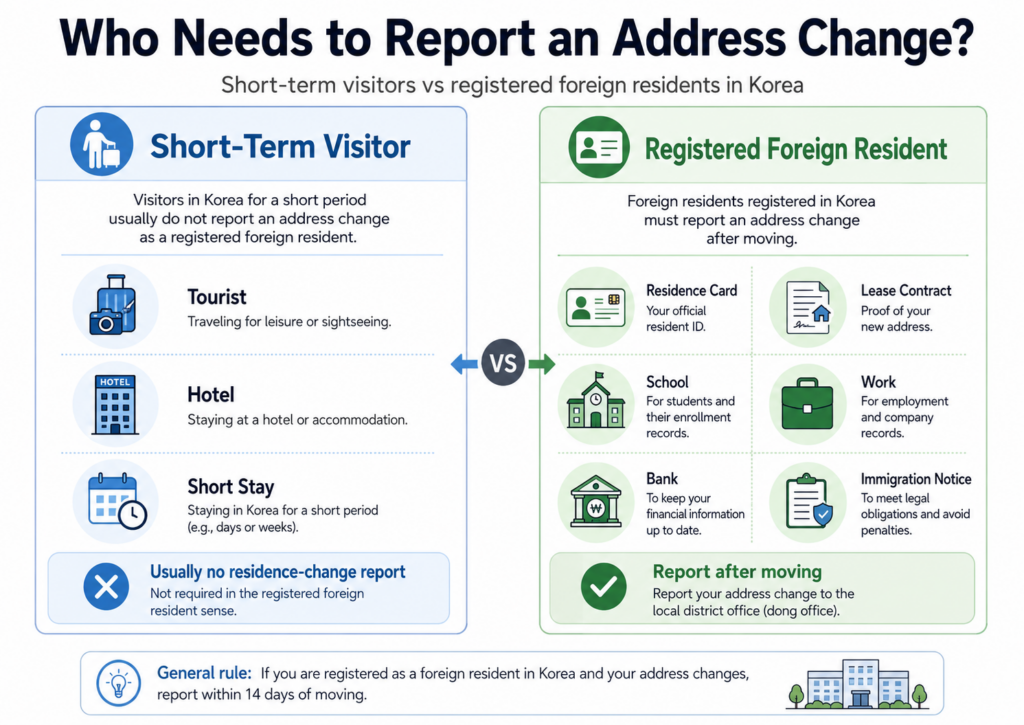
In general, registered foreign residents who move to a new address in Korea need to report their change of residence.
This may include:
Foreign students
Language students
Workers
English teachers
Researchers
Working holiday makers
Marriage migrants
Long-term residents
F visa holders
Foreigners with Residence Cards
Foreign nationality Koreans with domestic residence reports
Other registered long-term foreign residents
Short-term tourists usually do not report address changes in the same way because they are not registered residents with a Korean Residence Card.
However, if you have a Residence Card or domestic residence report, you should check your reporting duty carefully.
A simple rule is this:
If your address is printed, registered, or connected to your immigration record, you should check whether you need to update it after moving.
When Should You Report?
The safest answer is:
Report as soon as possible after moving.
Different official and local public pages may describe the period slightly differently. Some guidance says registered foreigners must report a change of residence within 15 days after moving. Some local public service pages mention 14 days, and some sources distinguish between registered foreigners and F-4 domestic residence status.
Because of this, do not wait and do not try to calculate the deadline too aggressively.
A practical rule for foreigners is:
Move to your new home.
Collect your proof of residence.
Report the new address immediately.
Try to finish it within 14 days to stay on the safe side.
If you are already late, contact immigration or visit the immigration office quickly.
If the deadline has passed, online reporting may not be available in some cases, and you may have to visit the immigration office.
Where Can You Report Address Change?
You may be able to report your new address through one of these places, depending on your status and location.
Immigration office
You can report the change at the immigration office that has jurisdiction over your new address.
This is usually the safest option if:
You are not sure about your status
You are late
Your documents are complicated
You moved across regions
You need immigration staff to confirm your record
You cannot complete the process online
Local district office or community service center
In many cases, registered foreigners may report address changes at a local district office, city office, county office, ward office, or community service center.
This can be convenient because it may be closer than the immigration office.
However, availability may vary by location and status. If you are unsure, call before visiting.
HiKorea online service
Some address change reports may be submitted online through HiKorea.
Online reporting can be convenient, but it may not be available for every situation.
Online reporting may not work if:
You missed the deadline
Your address proof is not accepted
Your status requires office confirmation
Your information does not match
You need to upload additional documents
The system does not recognize your case
If the online system fails, visit the immigration office or ask 1345.
Documents You May Need
Required documents can vary depending on your status, housing type, and reporting method.
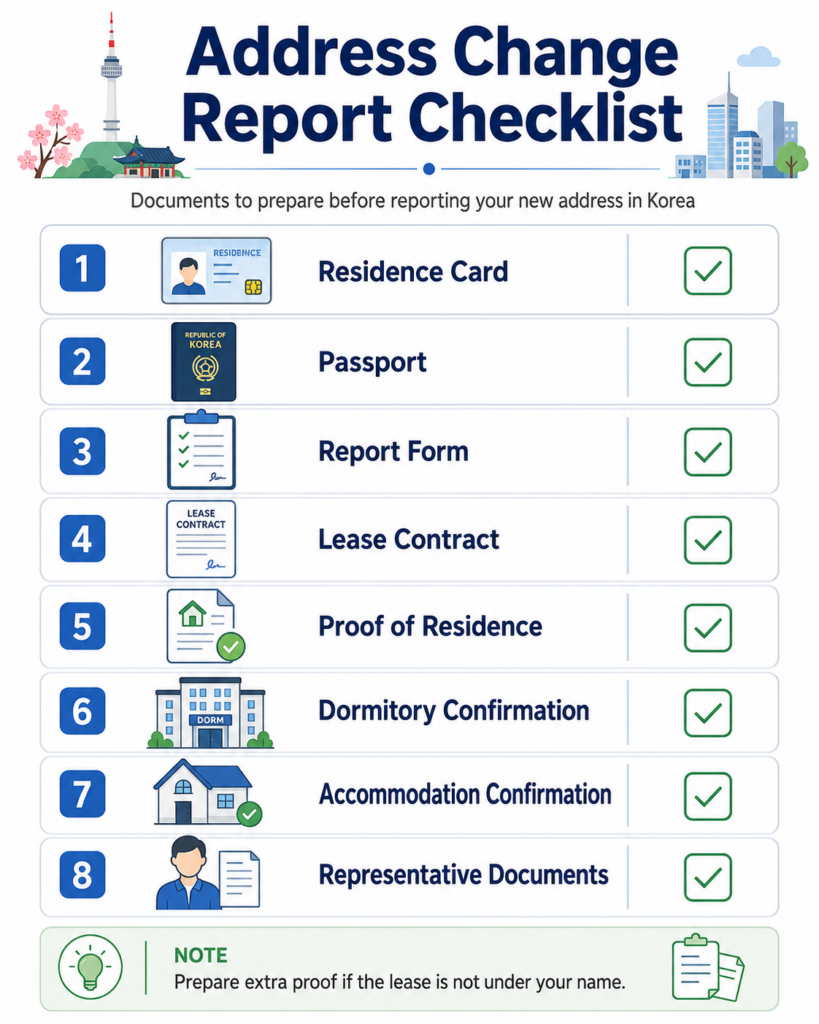
In general, prepare these before reporting your address change.
Residence Card
Passport
Change of residence report form
Proof of new address
Lease contract
Accommodation confirmation
Dormitory confirmation
Landlord confirmation
Copy of landlord or provider ID, if required
Representative documents, if someone else reports for you
The most important document is usually proof that you actually live at the new address.
What Counts as Proof of Residence?
Proof of residence is the document that shows where you actually live.
The accepted document can depend on your housing situation.
If you signed a lease under your own name
Prepare your lease contract.
The contract should show:
Your name
New address
Landlord or lessor information
Contract period
Move-in date or contract date
Signature or seal if applicable
If someone else signed the lease
This is common for foreigners living with a friend, spouse, family member, employer, or roommate.
You may need:
Accommodation confirmation form
Copy of the lease contract
Copy of the leaseholder’s ID
Document showing your relationship with the leaseholder, if required
Consent or confirmation from the housing provider
If you live in a dormitory
You may need a dormitory residence confirmation document from your school or dormitory office.
Ask your school’s international office for the correct document.
If you live in a goshiwon, guesthouse, or company housing
You may need:
Accommodation confirmation
Payment receipt
Business registration copy from the housing provider, if required
Confirmation letter from the owner or manager
Company housing confirmation, if applicable
Do not assume a simple screenshot or message will be accepted. Prepare official-looking documents whenever possible.
Step-by-Step: How to Report Address Change in Korea as a Foreigner
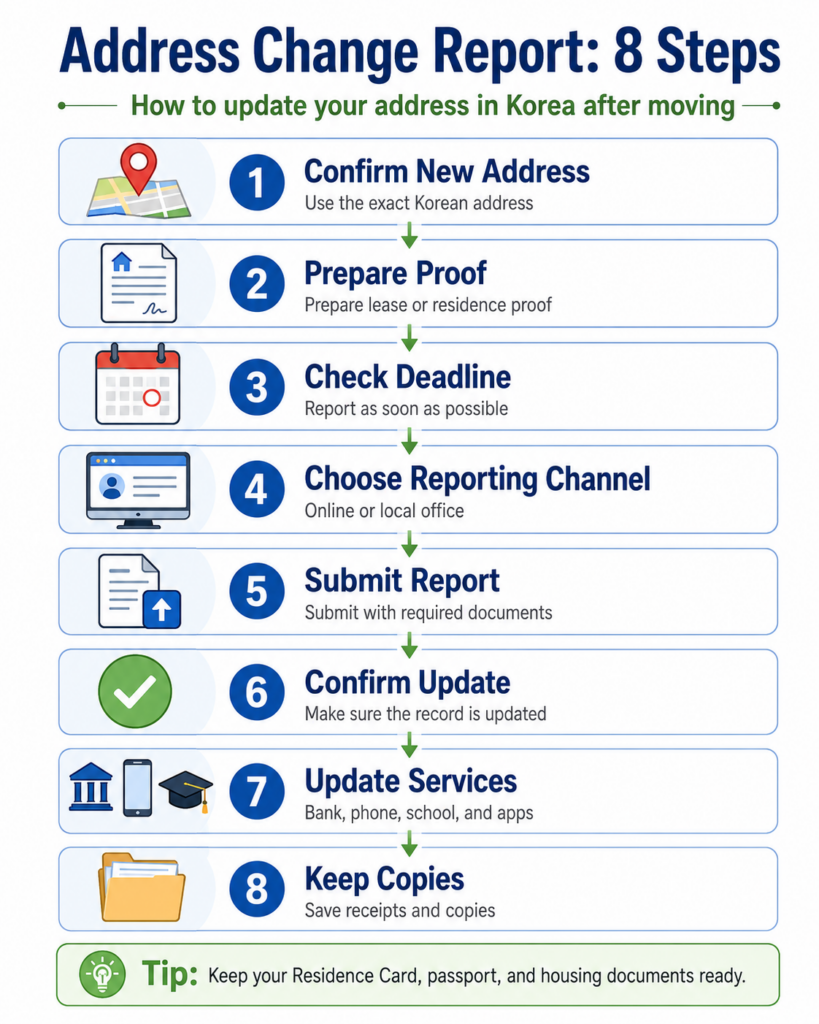
Step 01) Confirm your new address
Before reporting, make sure you know the exact Korean address.
You may need:
Road name address
Building name
Room number
Postal code
District or gu name
City or province
Check your lease contract carefully.
If your address is written differently in Korean and English, use the Korean address from the official contract or road-name address system.
Step 02) Prepare proof of residence
Prepare the document that proves you live at the new address.
This may be a lease contract, dormitory confirmation, accommodation confirmation, or other accepted address proof.
If the lease is not under your name, prepare extra documents before visiting.
Step 03) Check the deadline
Do not delay.
Try to report your new address as soon as possible after moving.
If you are already late, contact immigration or visit the immigration office.
Step 04) Choose where to report
Choose one of the accepted reporting channels.
HiKorea online service
Local immigration office
Local district office or community service center
If your case is simple, online or local office reporting may work.
If your case is complicated, the immigration office may be safer.
Step 05) Submit the report
Submit your address change report with your documents.
If you visit in person, bring your original Residence Card and passport.
If you apply online, scan or upload your documents clearly.
Step 06) Check that the new address is updated
After reporting, confirm that your new address is updated correctly.
Do not assume it is complete just because you submitted something.
If you applied online, check the processing result.
If you visited an office, ask whether the update is complete.
Step 07) Update other services
After immigration address change, update other important services if needed.
Bank account
Mobile carrier
School
Employer
Health insurance
Delivery apps
Shopping apps
Housing management office
Insurance services
Your immigration address and your bank or phone address may not automatically update together.
Step 08) Keep copies
Keep copies of your report, receipt, lease contract, and proof of residence.
You may need them later for visa extension, banking, housing, or school records.
Online Reporting Through HiKorea
HiKorea is the main online portal for many immigration-related services in Korea.
For some foreigners, address change reporting may be possible online.
This can be useful if:
You are within the reporting deadline
You have clear proof of residence
Your documents are ready as files
Your case is not complicated
Your information matches correctly
The online service is available for your status
However, online reporting is not always guaranteed.
If the system does not accept your documents or your case is outside the allowed conditions, you may need to visit an immigration office.
If you are late, do not rely on online reporting. Contact immigration or visit the office.
Reporting at a Local Office
Some foreigners may report their address change at a local public office such as a district office, city office, county office, ward office, or community service center.
This can be easier than going to immigration.
Before visiting, check:
Does this office handle foreigner address change reports?
Do I need an appointment?
What documents should I bring?
Can they process my visa status type?
Do they accept my proof of residence?
What happens if I am late?
If the staff says your case must be handled by immigration, visit the immigration office.
What If You Are Late?
If you miss the deadline, do not ignore it.
Late reporting can cause problems.
Possible issues may include:
Online reporting may not be available
You may need to visit immigration
Your visa extension may become more complicated
You may receive a warning or penalty
Your official notices may go to the wrong address
Your record may not match your actual living situation
If you are late, do this:
Prepare your documents.
Visit the immigration office as soon as possible.
Explain that you moved and need to report your new address.
Ask what steps are required.
Do not delay further.
Useful Korean sentence:
체류지 변경 신고 기간을 놓쳤습니다. 지금 신고하려면 어떻게 해야 하나요?
Meaning:
I missed the address change reporting deadline. What should I do to report it now?
Address Change and Your Residence Card
Your address change is connected to your Residence Card record.
After reporting your new address, your immigration record should be updated.
Depending on your situation, the physical card may or may not show updated address information the same way, but the official record must be correct.
Do not assume that moving house automatically updates your Residence Card record.
Your landlord, real estate agent, school, employer, or bank does not automatically report your immigration address change for you in most cases.
You are responsible for confirming that your address record is updated.
Address Change and Your Bank Account
After reporting your new address to immigration, you may also need to update your bank.
Banks may keep their own customer information.
If your bank address is outdated, you may miss:
Bank notices
Card delivery
Security notices
Tax-related mail
Remittance-related documents
Important account notifications
If you recently opened a Korean bank account, read this guide: Open a Bank Account in Korea as a Foreigner.
Address Change and Phone Verification
Your mobile carrier may also have your address or identity information.
Changing your immigration address does not always update your mobile carrier record automatically.
If your phone verification is failing, address may not be the main issue, but your overall identity record still matters.
Your name, Residence Card information, phone number, and carrier registration should match as much as possible.
If phone verification keeps failing, read: Korean Phone Verification for Foreigners: Why It Fails and How to Fix It.
Address Change and Housing Documents
Address change reporting depends heavily on housing documents.
This is why foreigners should keep housing paperwork organized.
Keep copies of:
Lease contract
Rent receipts
Accommodation confirmation
Dormitory confirmation
Landlord messages
Housing provider documents
Move-in date proof
Utility or management fee documents if available
This is especially important if:
Your name is not on the lease
You live with a friend
You live with family
Your employer provides housing
You live in a dormitory
You live in a goshiwon
You move often
If the proof of residence is unclear, your report may be delayed or rejected.
Useful Korean Sentences
To say you moved
이사를 해서 체류지 변경 신고를 하려고 합니다.
I moved and would like to report my change of residence.
To ask where to report
체류지 변경 신고는 어디에서 할 수 있나요?
Where can I report my change of residence?
To ask about required documents
체류지 변경 신고에 필요한 서류가 무엇인가요?
What documents are required to report a change of residence?
To say the lease is not under your name
임대차계약서가 제 명의가 아닙니다. 어떤 서류가 추가로 필요한가요?
The lease contract is not under my name. What additional documents do I need?
To say you live in a dormitory
기숙사에 살고 있습니다. 기숙사 거주확인서로 신고할 수 있나요?
I live in a dormitory. Can I report with a dormitory residence confirmation?
To say you are late
체류지 변경 신고 기간을 놓쳤습니다. 지금 신고하려면 어떻게 해야 하나요?
I missed the address change reporting deadline. What should I do now?
To check if the update is complete
새 주소로 변경 처리가 완료되었는지 확인해 주실 수 있나요?
Can you check whether my new address has been updated?
Common Mistakes to Avoid
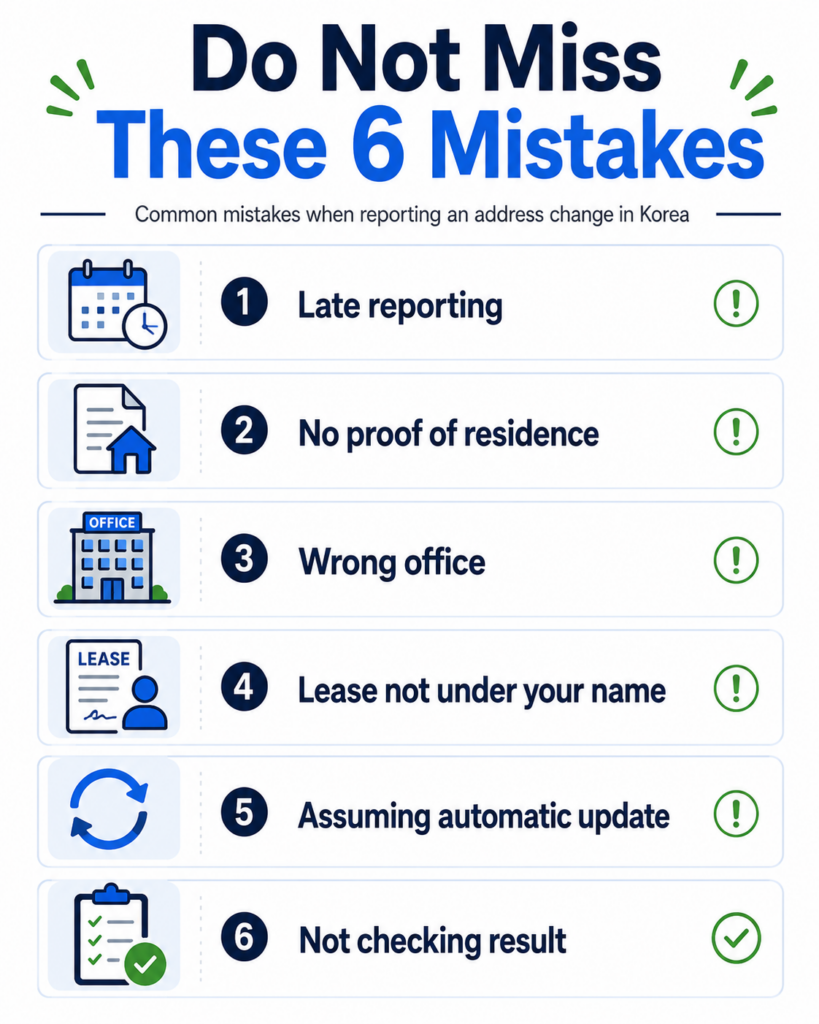
Do not wait until the last day.
Do not assume your landlord reports it for you.
Do not assume your school reports it for you.
Do not assume your employer reports it for you.
Do not assume updating your bank address updates immigration records.
Do not report with unclear proof of residence.
Do not forget your Residence Card.
Do not forget your passport if visiting in person.
Do not use the wrong address format.
Do not ignore online rejection messages.
Do not delay if you already missed the deadline.
Do not throw away your lease or accommodation confirmation.
Practical Checklist Before Reporting
Before you report address change in Korea as a foreigner, check this list.
You moved to the new address.
You know your exact Korean address.
You have your Residence Card.
You have your passport.
You have proof of residence.
You know whether your lease is under your name.
You prepared extra documents if someone else signed the lease.
You checked the reporting deadline.
You know where to report.
You checked whether online reporting is possible.
You saved copies of your documents.
You confirmed the update after reporting.
FAQ
Do foreigners need to report address change in Korea?
Yes, registered foreign residents generally need to report a change of residence after moving to a new address in Korea.
When should I report my address change?
Report it as soon as possible after moving. Some guidance mentions 15 days, while some local pages mention 14 days depending on status or category. To be safe, report immediately and confirm your exact deadline with immigration or 1345.
Can I report address change online?
In some cases, yes. HiKorea may allow online reporting if you are eligible and within the deadline. If the system rejects your application, visit the immigration office.
Where can I report address change?
Depending on your status and location, you may report at a local immigration office, local district office, community service center, or through HiKorea online service.
What documents do I need?
Common documents include your Residence Card, passport, change report form, and proof of residence such as a lease contract, dormitory confirmation, or accommodation confirmation.
What if my lease is not under my name?
You may need additional documents such as an accommodation confirmation, leaseholder ID copy, lease contract copy, or relationship proof. Requirements can vary, so confirm with the office before visiting.
What happens if I report late?
You may need to visit immigration, and there may be complications or penalties depending on the situation. Do not delay further. Prepare your documents and contact immigration.
Does changing my address with the bank update immigration?
No, not usually. Updating your bank, phone carrier, school, or employer address does not automatically update your immigration address record. You should report your address change through the proper immigration or public office process.
Do I need to update my bank and phone carrier too?
It is a good idea. Immigration address change and bank or carrier customer information may be separate systems.
Should I keep my old lease documents?
Yes. Keep copies of old and new housing documents. You may need them later for visa extension, address proof, or resolving record issues.
Final Thoughts
Report address change in Korea as a foreigner quickly after moving.
This is not just a housing task. It is part of your immigration and residence management in Korea.
Your address connects to your Residence Card, visa status, official notices, banking, phone verification, health insurance, school, work, and other daily life systems.
The process is usually not difficult if your documents are ready.
But it can become stressful if you wait too long, lose your lease documents, report to the wrong office, or assume someone else handled it for you.
The best approach is simple.
Move to your new home.
Prepare proof of residence.
Report your address quickly.
Check that the update is complete.
Then update your bank, phone carrier, school, employer, and important apps if needed.
A correct address record can prevent many problems later.
For foreigners living in Korea, address change reporting is one of the small tasks that protects your long-term stay.