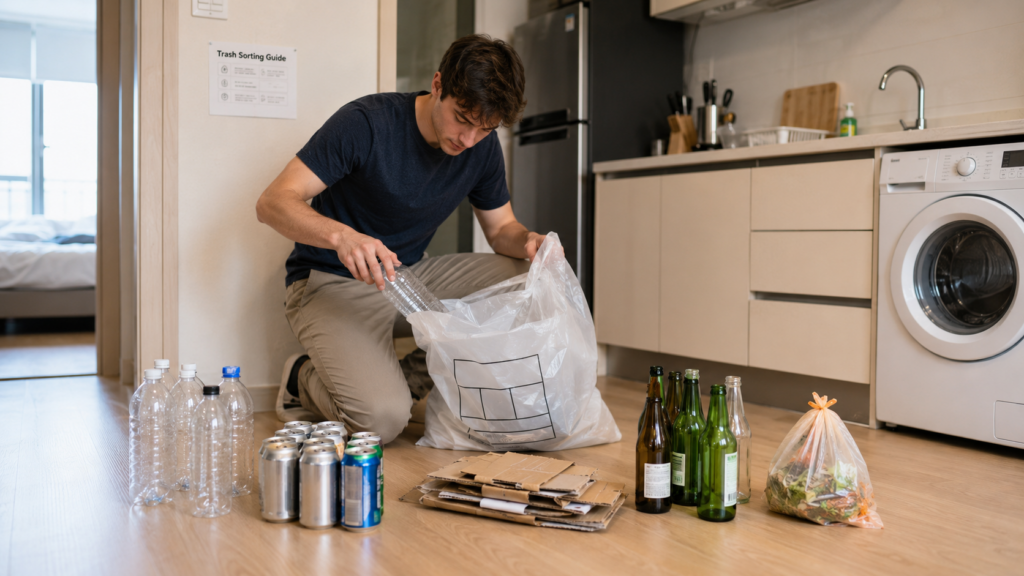
Korean trash disposal for foreigners can feel confusing at first.
In Korea, you usually cannot put all trash into one random plastic bag.
You need to separate waste by type.
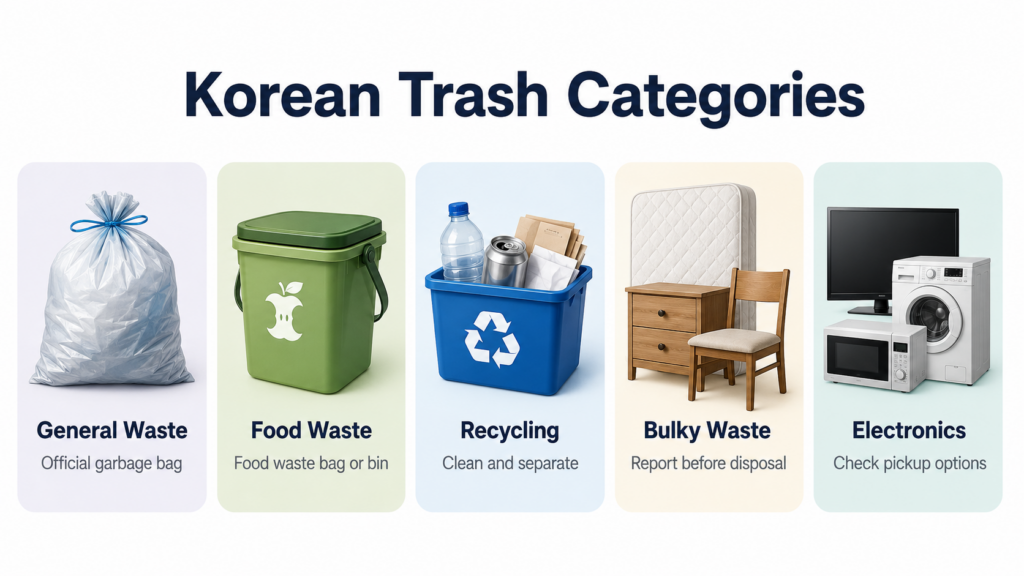
The main categories are:
General waste
Food waste
Recyclables
Large waste
Electronics
Special waste
The exact rules can change by city, district, apartment, officetel, villa, or building.
So the safest rule is simple.
Follow your building notice first.
Follow your district office rules second.
Ask before guessing.
If you are still setting up your home, also read Korean Maintenance Fee for Foreigners and Pay Utilities in Korea as a Foreigner.
Quick Answer
In Korea, most daily household waste must be separated.
General waste usually goes into official volume-rate garbage bags called 종량제봉투.
Food waste usually goes into food waste bags, food waste bins, or RFID food waste machines depending on the building.
Recyclables should usually be emptied, rinsed, separated, and placed in the correct recycling area.
Large items such as mattresses, desks, chairs, and furniture usually require a bulky waste report, sticker, or online application.
Large home appliances may be eligible for free pickup through Korea’s e-waste pickup system, depending on the item and conditions. E-순환거버넌스 explains that it works with local governments and apartment complexes to collect discarded electronics through designated pickup systems: E-순환거버넌스.
Seoul also provides food waste separation standards for foreign residents. Seoul’s guide says items such as meat bones, fish bones, shellfish shells, eggshells, hard fruit seeds, onion and garlic skins, tea grounds, and non-food objects should not be thrown away as food waste: Seoul food waste disposal standard.
The 5 Main Trash Categories in Korea
Korean household waste is easier to understand if you divide it into five groups.
| Category | Korean | Common Method |
|---|---|---|
| General waste | 일반쓰레기 | Official volume-rate bag |
| Food waste | 음식물쓰레기 | Food waste bag, bin, or RFID machine |
| Recyclables | 재활용품 | Sorted by material |
| Bulky waste | 대형폐기물 | Report and pay before disposal |
| Electronics | 폐가전 | Free pickup or local disposal method |
The important part is not just what the item is.
The important part is whether it is clean, recyclable, food waste, or too large for a normal bag.
General Waste: 일반쓰레기
General waste means non-recyclable daily trash.
It usually goes into a designated official garbage bag called 종량제봉투.
Examples may include:
Used tissues
Wet wipes
Contaminated paper
Contaminated plastic
Receipts
Small broken items
Dust and vacuum waste
Pet waste, depending on local rules
Food packaging that cannot be cleaned
You can usually buy 종량제봉투 at:
Convenience stores
Supermarkets
Local marts
Some neighborhood shops
Ask for:
종량제봉투 주세요.
Meaning:
Please give me a volume-rate garbage bag.
You may need to say the size:
10리터 주세요.
20리터 주세요.
Meaning:
Please give me a 10-liter bag.
Please give me a 20-liter bag.
Important: buy bags for your area.
In many places, garbage bags are issued by local district or city. If you use the wrong local bag, collection may be refused.
Useful Korean sentence:
이 지역 종량제봉투 맞나요?
Meaning:
Is this the correct garbage bag for this area?
Food Waste: 음식물쓰레기
Food waste is one of the most confusing parts for foreigners.
In Korea, food waste is not simply “anything from the kitchen.”
A rough rule is:
If it can be processed as food waste, it goes into food waste.
If it can damage machines or cannot be recycled as food waste, it goes into general waste.
Seoul’s official food waste standard lists many items that should not go into food waste, including onion skins, garlic skins, hard shells, peach and persimmon seeds, meat bones, fish bones, shellfish shells, crab shells, eggshells, tea grounds, and non-food objects. Seoul also recommends removing moisture before disposal: Seoul food waste disposal standard.
Usually food waste can include:
Rice
Noodles
Vegetable leftovers
Fruit flesh
Soft fruit peels
Leftover side dishes
Cooked food scraps
Usually not food waste:
Bones
Eggshells
Shellfish shells
Crab shells
Fruit pits
Onion skins
Garlic skins
Tea bags
Coffee grounds
Toothpicks
Plastic
Vinyl
Bottle caps
How to dispose:
Remove liquid
Put it in a food waste bag or bin
Use the building’s RFID machine if available
Follow the building schedule
Useful Korean sentence:
음식물쓰레기는 어디에 버리면 되나요?
Meaning:
Where should I throw away food waste?
Recycling: 재활용품
Recycling in Korea is usually sorted by material.
Common recycling categories include:
Paper
Cardboard
Plastic
Transparent PET bottles
Vinyl/plastic film
Glass bottles
Cans
Metal
Styrofoam
The key rule is:
Empty.
Rinse.
Separate.
Sort.
For example:
Empty bottles before disposal.
Rinse food containers.
Remove labels from PET bottles.
Remove tape and shipping labels from boxes.
Separate caps if your building requires it.
Do not recycle items with heavy food contamination.
The “내손안의 분리배출” app says it provides correct separate collection methods with support from the Ministry of Environment, Korea Environment Corporation, Korea Packaging Recycling Cooperative, and Korea Resources Circulation Service Agency: 내손안의 분리배출 app.
Useful Korean sentence:
이건 재활용인가요, 일반쓰레기인가요?
Meaning:
Is this recycling or general waste?
Transparent PET Bottles
Transparent PET bottles are often separated from other plastic.
For water bottles and clear drink bottles:
Empty the bottle
Rinse if needed
Remove the label
Crush the bottle
Follow your building rule for the cap
Put it in the transparent PET area
Do not mix colored plastic bottles with transparent PET if your building separates them.
Useful Korean sentence:
투명 페트병은 따로 버리나요?
Meaning:
Do I throw away transparent PET bottles separately?
Paper and Cardboard
Paper and cardboard should be clean and dry.
For cardboard boxes:
Remove delivery labels
Remove tape
Flatten the box
Stack or tie if required
Do not recycle:
Greasy pizza boxes
Wet paper
Used tissues
Receipts
Coated paper
Food-contaminated paper
If it is dirty and cannot be cleaned, it usually goes into general waste.
Plastic, Vinyl, and Styrofoam
Plastic can be recycled only when it is clean enough.
For plastic containers:
Empty contents
Rinse food residue
Remove labels if possible
Separate different materials if possible
Vinyl and plastic film should be clean and dry.
Styrofoam should usually be white, clean, and free from tape or labels.
If food, oil, sauce, or dirt cannot be removed, it may need to go into general waste.
Useful Korean sentence:
이 플라스틱은 씻어서 버리면 되나요?
Meaning:
Can I rinse and recycle this plastic?
Glass, Cans, and Metal
Glass bottles and cans should be emptied.
For cans:
Empty
Rinse
Remove food residue
Crush if required by your building
For glass:
Empty
Rinse
Remove caps if required
Do not mix broken glass with normal glass bottles
Broken glass, mirrors, ceramics, and heat-resistant glass may follow different local rules.
Useful Korean sentence:
깨진 유리는 어떻게 버리나요?
Meaning:
How should I throw away broken glass?
Bulky Waste: 대형폐기물
Bulky waste means items that are too large for a normal trash bag.
Examples:
Mattress
Bed frame
Desk
Chair
Sofa
Bookshelf
Drawer
Large mirror
Carpet
Large household items
You usually cannot just leave these outside.
You may need to:
Apply through your district office website
Use a local bulky waste app or service
Pay the disposal fee
Print or write the report number
Attach the sticker or number to the item
Put it out at the correct place and time
Rules and fees vary by district.
Useful Korean sentence:
대형폐기물은 어디에서 신고하나요?
Meaning:
Where do I report bulky waste?
Another useful sentence:
이 물건은 대형폐기물인가요?
Meaning:
Is this item bulky waste?
Electronics and Appliances
For large appliances, check whether free pickup is available.
E-순환거버넌스 provides electronics recycling and pickup-related services in cooperation with local governments and apartment complexes: E-순환거버넌스.
Common eligible items may include:
Refrigerator
Washing machine
TV
Air conditioner
Large appliances
Small appliances may have different conditions.
Before paying for bulky waste disposal, check whether the item can be collected through an electronics recycling program.
Useful Korean sentence:
폐가전 무상수거 신청이 가능한가요?
Meaning:
Can I apply for free pickup for this used appliance?
Trash Disposal Time and Place
Trash disposal rules are very local.
Your building may have:
Specific trash days
Specific recycling days
Food waste machine hours
A designated trash area
A separate recycling room
Different rules for apartments and villas
Do not put trash out too early unless your building allows it.
Ask your landlord, real estate agent, building manager, or management office.
Useful Korean sentence:
쓰레기는 몇 시에 어디에 버리면 되나요?
Meaning:
What time and where should I throw away trash?
Another useful sentence:
재활용 배출일은 언제인가요?
Meaning:
When is recycling day?
Common Mistakes Foreigners Make
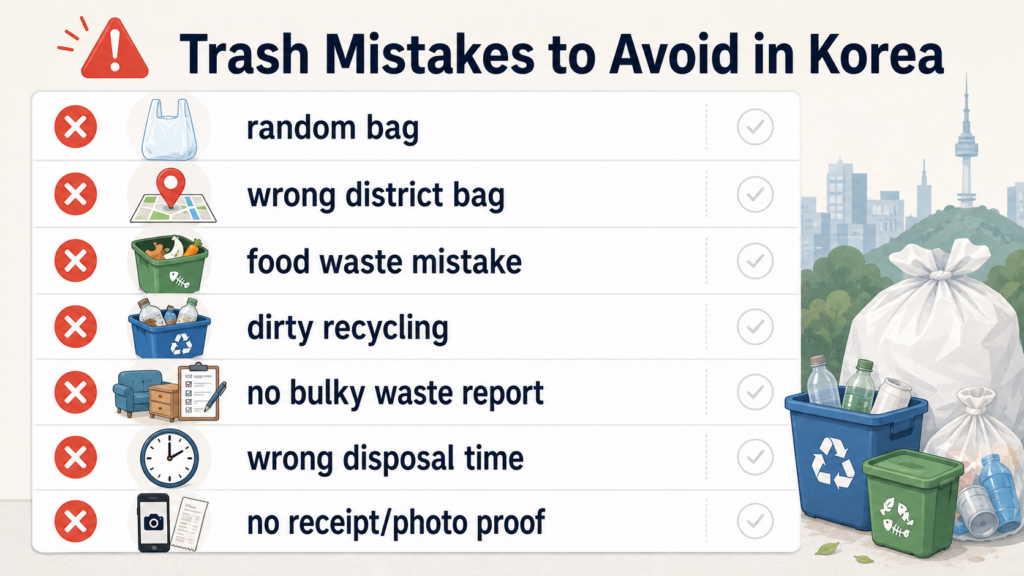
| Mistake | Why It Is a Problem | Better Action |
| Using a random plastic bag | It may not be collected | Use local 종량제봉투 |
| Mixing food waste with general waste | Building may reject it | Separate food waste |
| Putting bones in food waste | Often not accepted | Put bones in general waste |
| Recycling dirty containers | Contamination can cause rejection | Rinse or use general waste |
| Leaving furniture outside | Can be illegal dumping | Report bulky waste first |
| Ignoring building schedule | Trash may not be collected | Check disposal day |
| Using another district’s bag | Collection may be refused | Buy local bags |
| Throwing away electronics as normal trash | Some items need special handling | Check free pickup or local rules |
Step-by-Step: How to Throw Away Trash in Korea
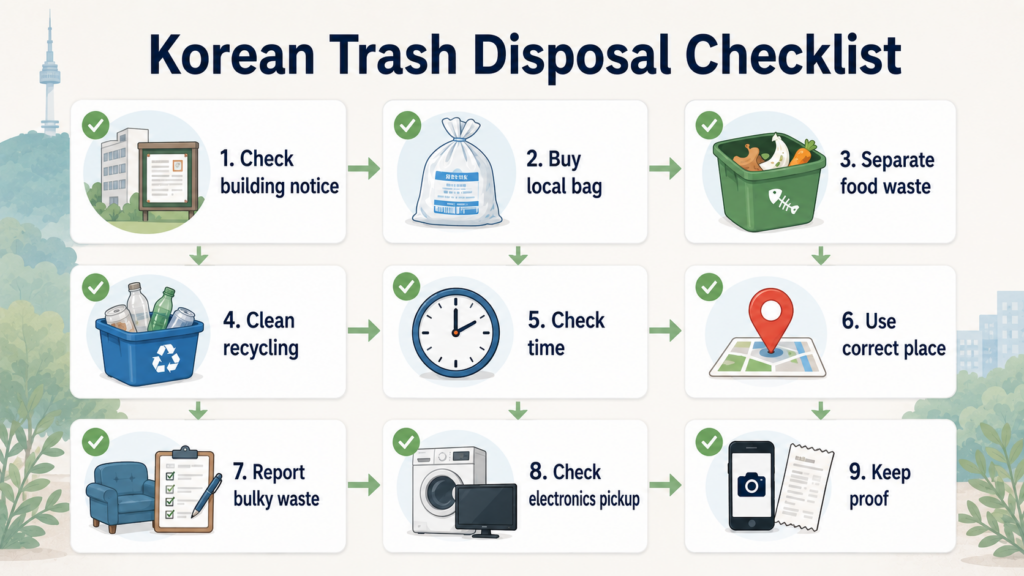
Step 01) Check your building notice
Look for trash rules in the elevator, lobby, recycling room, or building chat.
Step 02) Buy the correct local garbage bag
Ask for 종량제봉투 at a convenience store or mart near your home.
Step 03) Separate food waste
Use food waste bags, bins, or RFID machines depending on your building.
Step 04) Clean recyclables
Empty, rinse, remove labels, and sort by material.
Step 05) Check disposal day and time
Do not assume every day is allowed.
Step 06) Use the correct disposal place
Apartment, officetel, villa, and one-room buildings may have different locations.
Step 07) Report bulky waste before disposal
Do not leave furniture outside without reporting.
Step 08) Check electronics pickup
Some used appliances may be collected through free e-waste pickup.
Step 09) Take photos when moving out
If you are moving out, keep proof that bulky waste or final trash was handled properly.
Useful Korean Sentences
종량제봉투 주세요.
Please give me a volume-rate garbage bag.
20리터 종량제봉투 주세요.
Please give me a 20-liter garbage bag.
이 지역 종량제봉투 맞나요?
Is this the correct garbage bag for this area?
음식물쓰레기는 어디에 버리면 되나요?
Where should I throw away food waste?
재활용 배출일은 언제인가요?
When is recycling day?
쓰레기는 몇 시에 어디에 버리면 되나요?
What time and where should I throw away trash?
이건 재활용인가요, 일반쓰레기인가요?
Is this recycling or general waste?
대형폐기물은 어디에서 신고하나요?
Where do I report bulky waste?
폐가전 무상수거 신청이 가능한가요?
Can I apply for free pickup for this used appliance?
Final Trash Disposal Checklist
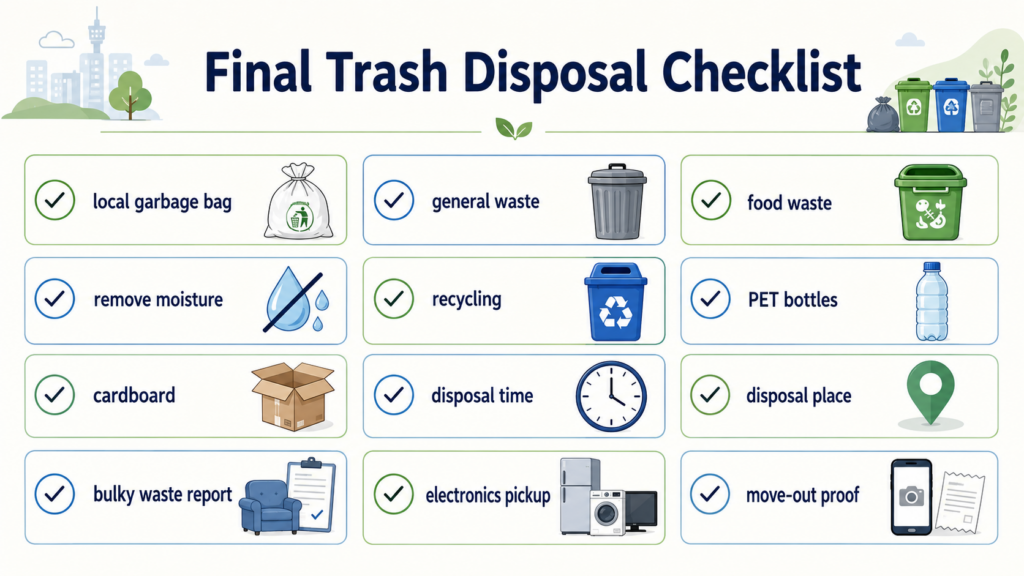
Before throwing away trash, check this list.
You bought the correct local garbage bag.
You separated general waste.
You separated food waste.
You removed liquid from food waste.
You checked what is not food waste.
You emptied recyclable containers.
You rinsed dirty recyclables.
You removed labels and tape.
You separated transparent PET bottles if required.
You checked the building disposal day.
You checked the disposal time.
You used the correct disposal area.
You reported bulky waste before putting it outside.
You checked electronics free pickup if needed.
You kept proof when moving out.
FAQ
What is 종량제봉투?
종량제봉투 is an official volume-rate garbage bag used for general waste in Korea.
Can I use any plastic bag for trash in Korea?
Usually no. General waste should normally go into the official local garbage bag.
Where can I buy garbage bags in Korea?
You can usually buy them at convenience stores, supermarkets, and local marts near your home.
Is food waste separate in Korea?
Yes. Food waste is usually separated and disposed of through food waste bags, bins, or RFID machines.
Are bones food waste?
Usually no. Meat bones and fish bones are commonly treated as general waste, not food waste.
Are eggshells food waste?
Usually no. Seoul’s food waste standard lists eggshells as items not to dispose of as food waste.
Do I need to wash recycling?
Yes. Recyclables should generally be emptied and rinsed. Dirty items may not be accepted as recycling.
Can I throw away furniture outside?
Not without checking first. Furniture usually requires bulky waste reporting and payment.
How do I throw away a mattress in Korea?
Check your district office or building manager. You usually need to report it as bulky waste and pay a fee.
Can I throw away electronics for free?
Some large appliances may be eligible for free pickup through e-waste collection services. Check E-순환거버넌스 or your local district.
What if I do not know the rule?
Ask your landlord, management office, building manager, district office, or use the 내손안의 분리배출 app.
Are trash rules the same everywhere in Korea?
No. Rules can vary by city, district, and building. Always check your local rules.
Final Thoughts
Korean trash disposal for foreigners can feel strict at first, but the system becomes easier once you know the basic categories.
Use 종량제봉투 for general waste.
Separate food waste carefully.
Clean recyclables before throwing them away.
Report bulky waste before putting it outside.
Check your building notice and local district rules.
The safest habit is to ask before guessing.
Good trash disposal protects you from rejected collection, conflict with neighbors, and possible fines.