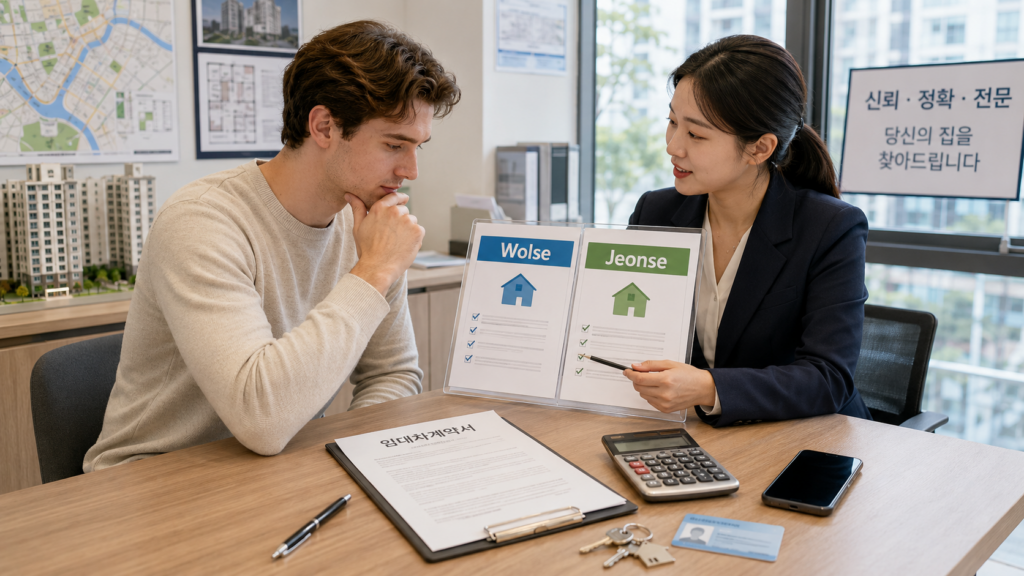
Jeonse deposit return guide for foreigners is essential if you are renting a home in Korea with a large deposit.
Jeonse can look attractive because you usually do not pay monthly rent. But the risk is also bigger because your money is concentrated in one large deposit.
For foreigners, the problem is not only understanding the word jeonse. The real question is this:
Will I get my deposit back safely when the lease ends?
A Korean lease deposit can affect your savings, visa plans, move-out schedule, next home, bank loan, and even your ability to leave Korea smoothly.
Before signing a high-deposit lease, you should understand how jeonse deposit return works, what can go wrong, what documents to keep, and what to do if the landlord delays payment.
If you are still learning the difference between wolse, jeonse, and banjeonse, read this first: Wolse vs Jeonse for Foreigners.
If you are preparing to sign a rental contract, read this checklist too: Korean Lease Contract Checklist for Foreigners.
If you move to a new home after the lease ends, you may also need this guide: Report Address Change in Korea as a Foreigner.
Quick Answer
Jeonse deposit return means the landlord should return your jeonse deposit when your lease ends.
In Korea, Seoul Metropolitan Government explains that jeonse is a system where the tenant entrusts the landlord with a certain amount as deposit, usually leases the home for 1 to 2 years, and the landlord must return the jeonse amount after the contract ends. You can review the official overview of wolse and jeonse from Seoul.
However, getting the deposit back is not always automatic in real life.
Problems can happen if:
The landlord does not have enough money.
The landlord delays returning the deposit.
The property has debt or senior rights.
The next tenant has not moved in yet.
The contract terms are unclear.
The tenant did not keep records.
The tenant did not complete important protection steps.
For foreigners, the safest approach is:
Check the property before signing.
Use bank transfer for deposit payments.
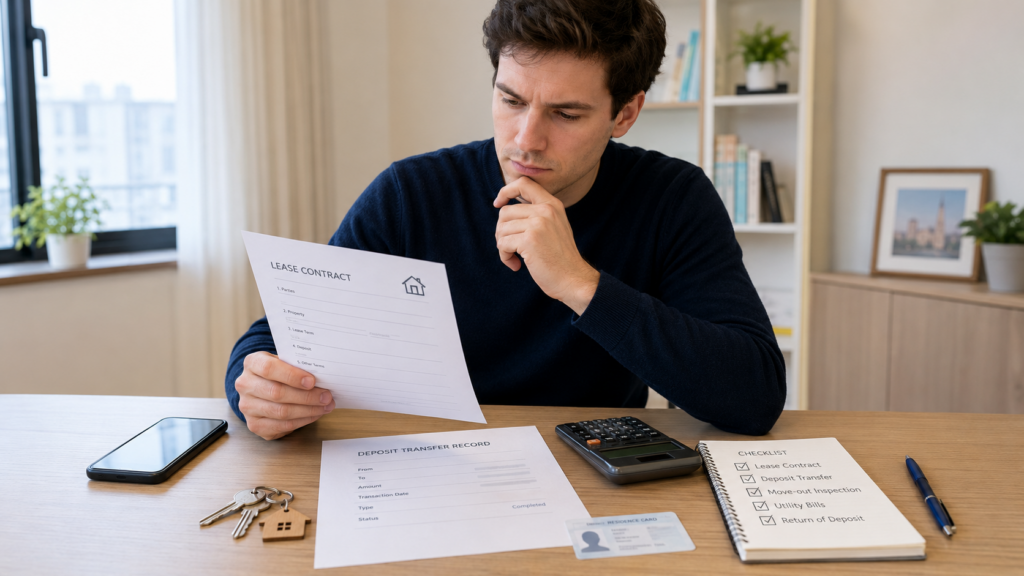
Keep the lease contract and payment records.
Complete address reporting if required.
Ask about fixed date and lease reporting.
Check deposit return guarantee options if eligible.
Give move-out notice clearly and in writing.
Prepare evidence before the lease ends.
Do not wait until move-out day to think about deposit return.
Start protecting your deposit before signing the contract.
Why Jeonse Deposit Return Is a Big Issue
Jeonse is different from regular monthly rent.
With wolse, your deposit may be smaller and your monthly rent is the main cost.
With jeonse, your monthly rent may be zero, but your deposit can be very large.
That means your biggest risk is not monthly affordability.
Your biggest risk is whether the landlord can return your deposit at the end.
A delayed deposit can create serious problems.
You may not be able to pay the deposit for your next home.
You may not be able to repay your jeonse loan.
You may miss your move-out plan.
You may have trouble leaving Korea.
You may need legal help.
You may have to stay longer than expected.
For foreigners, this can be even more stressful because of language, visa, work, school, and banking issues.
That is why this guide focuses on prevention first.
What Is Jeonse Deposit?
Jeonse deposit is a large lump-sum payment that the tenant gives to the landlord during the lease period.
In return, the tenant usually lives in the home without paying monthly rent.
At the end of the contract, the landlord should return the deposit.
A simple example:
Jeonse deposit: KRW 150,000,000
Monthly rent: KRW 0
Maintenance fee: separate
Lease period: 2 years
This looks simple.
But the deposit is not small.
If the deposit is delayed, your next move can become difficult.
This is why jeonse should never be treated like a normal small rental deposit.
Who Should Be Extra Careful?
Every tenant should be careful with jeonse.
But foreigners should be extra careful if:
You do not speak Korean well.
You are new to Korea.
You are using most of your savings.
You are using a jeonse loan.
You do not fully understand the contract.
You are renting a villa or multi-family house.
You are signing without a trusted person.
You are paying a very large deposit.
You are not sure how to check the property register.
You are not sure whether your address can be reported.
You may leave Korea soon after the lease ends.
If several of these apply to you, do not rush.
You may need more support before signing.
Before Signing: Check the Property Register
This is one of the most important steps.
Before paying a large jeonse deposit, ask the real estate agent to help you check the real estate register.
Easy Law explains that before signing a lease, tenants should check the current condition of the property and legal rights of the owner, mortgage holders, and existing tenants through the certified copy of the real estate register. Read the official Easy Law explanation on lease agreements and key signing checks.
Ask these questions:
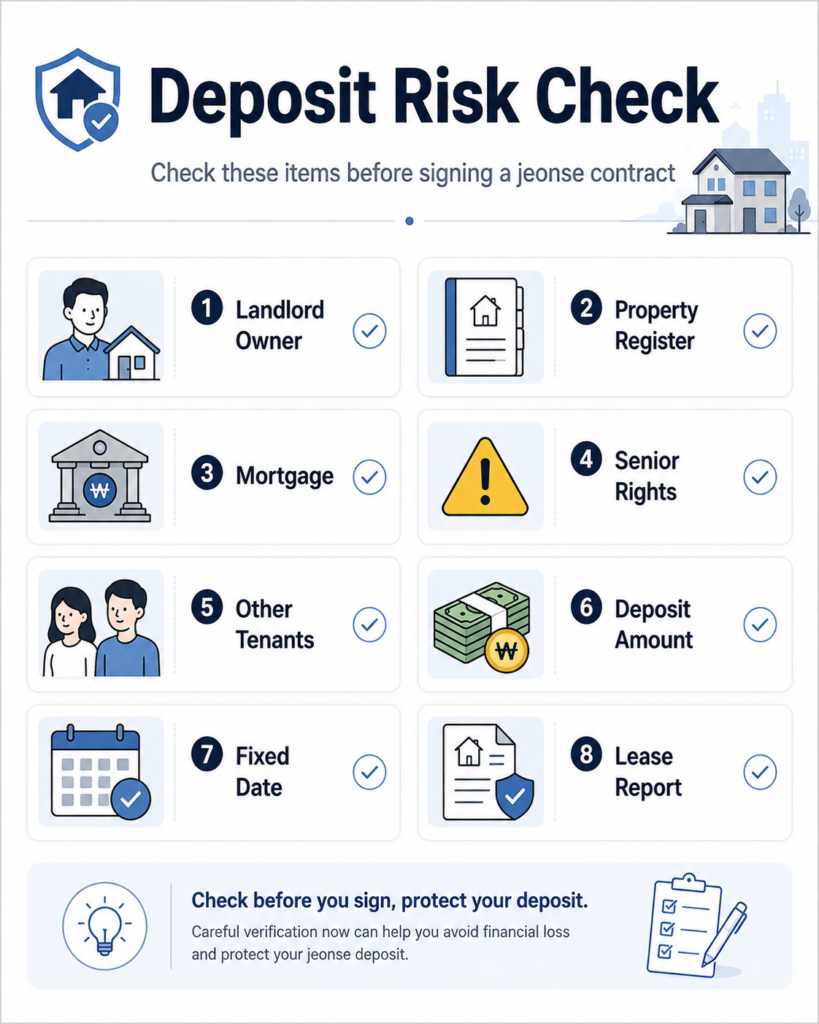
Is the landlord the registered owner?
Are there mortgages?
Are there senior rights?
Are there other tenants with deposits?
Is the deposit reasonable compared to the property value?
Has the ownership changed recently?
Is there anything registered after the listing was shown?
Useful Korean sentence:
등기부등본을 확인해 주실 수 있나요?
Meaning:
Can you help me check the real estate register?
Another useful sentence:
근저당이나 선순위 권리가 있는지 확인하고 싶습니다.
Meaning:
I want to check whether there is a mortgage or senior priority right.
If you cannot read Korean legal documents, do not check alone.
Ask a licensed agent, Korean speaker, school office, employer, lawyer, legal center, or housing support center for help.
Check the Landlord and Payment Account
Before sending any deposit, check the payment account.
The landlord name in the contract and the bank account name should make sense.
Be careful if:
The account name is different from the landlord.
The agent tells you to send money quickly.
The contract is not ready but payment is requested.
The explanation changes several times.
You are asked to send money to a third party.
You are told a receipt is not necessary.
Sometimes there may be a legitimate reason for a different account.
But you should never ignore it.
Ask:
보증금을 입금할 계좌 명의가 임대인과 같은지 확인하고 싶습니다.
Meaning:
I would like to check whether the deposit account name is the same as the landlord.
If the account is different:
계좌 명의가 다른 이유를 설명해 주실 수 있나요?
Meaning:
Can you explain why the account name is different?
Use bank transfer whenever possible.
Keep screenshots and transfer confirmations.
Address Reporting and Foreign Tenant Protection
For foreigners, address reporting is not just an immigration task.
It can also be connected to tenant protection.
Easy Law explains that foreign nationals are generally not covered under the Housing Lease Protection Act in principle, but a foreign national who leased a residence may be exceptionally protected if they completed alien registration and reported their change of residence. You can read the official explanation on Housing Lease Protection Act and foreign tenants.
This is why foreigners must check whether the address can be used for official residence reporting.
Ask before signing:
이 주소로 외국인등록증 체류지 변경 신고가 가능한가요?
Meaning:
Can I report this address for my Residence Card address change?
Be extra careful with:
Goshiwon
Share house
Sublet room
Company housing
Dormitory
Short-term rental
Room not under your name
Non-standard accommodation
If you cannot report the address properly, you may have problems later.
Fixed Date and Lease Reporting
Two terms matter a lot in Korean lease protection.
Fixed date
Lease reporting
A fixed date helps prove when your lease contract existed.
Lease reporting may also be required for certain contracts.
Seoul Foreign Portal explains that certain housing lease contracts must be reported within 30 days from the signing date if they meet the reporting conditions.
The same guidance explains that filing the lease report can officially prove the lease relationship and that a fixed date is issued automatically when the report is filed.
Ask your agent or local office:
이 임대차계약은 전월세 신고 대상인가요?
Meaning:
Is this lease contract subject to housing lease contract reporting?
Also ask:
확정일자를 받을 수 있나요?
Meaning:
Can I get a fixed date?
For large deposits, do not skip this section.
Jeonse Deposit Return Guarantee
One way to reduce risk is to check deposit return guarantee options.
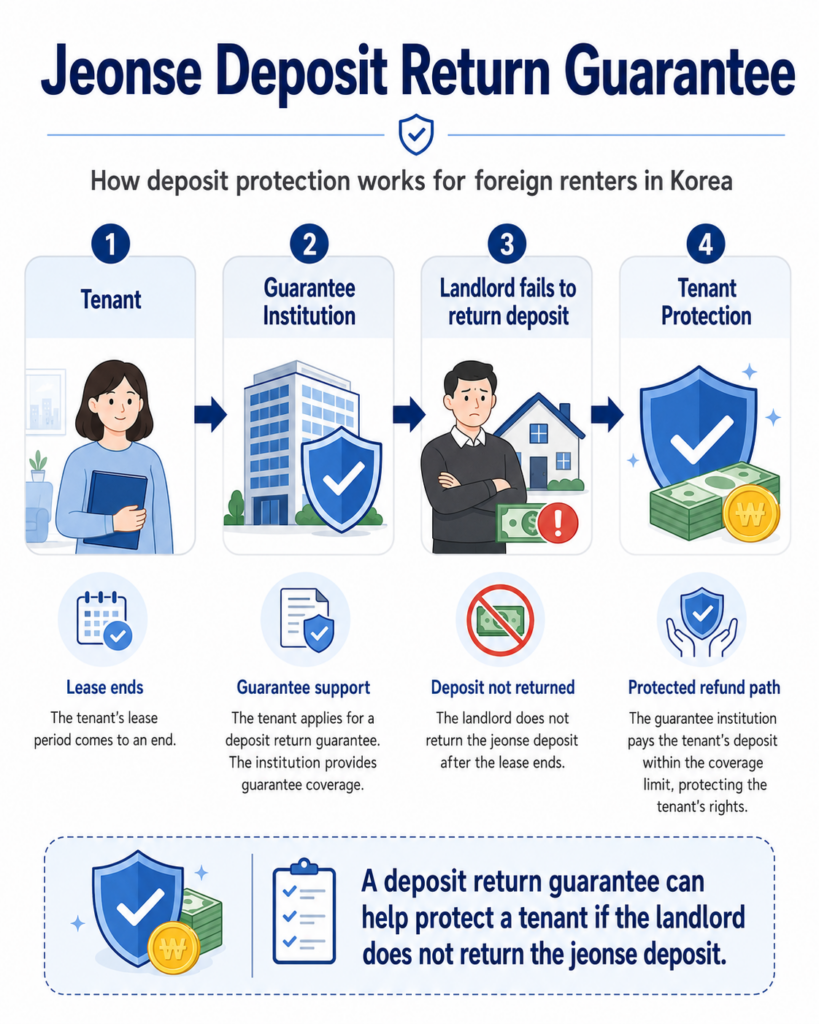
HUG explains that its guarantee product can guarantee the return of jeonse deposit to the tenant upon termination of a jeonse lease agreement if the landlord fails to return the deposit. You can check HUG’s official English page for Guarantee for Jeonse Deposit Refund.
Easy Law also lists major guarantee institutions such as HUG, Korea Housing Finance Corporation, and Seoul Guarantee Insurance for housing lease deposit refund-related guarantees.
However, do not assume you are automatically eligible.
Eligibility can depend on:
Housing type
Deposit amount
Contract type
Registration status
Existing property debt
Lease reporting status
Move-in and address reporting status
Application timing
Bank or guarantee institution requirements
Ask before signing:
전세보증금 반환보증 가입이 가능한 집인가요?
Meaning:
Is this home eligible for jeonse deposit return guarantee?
Also ask:
보증보험 가입 조건을 확인할 수 있나요?
Meaning:
Can we check the guarantee insurance requirements?
If the deposit is large, this question is not optional.
It is one of the most important questions.
What to Do During the Lease Period
Protecting your deposit does not end after signing.
During the lease period, keep records.
Save:
Signed lease contract
Deposit transfer record
Monthly maintenance fee records
Utility payment records
Messages with landlord
Messages with agent
Repair requests
Photos and videos
Lease reporting confirmation
Fixed date confirmation
Address change report confirmation
Guarantee documents, if applicable
Do not rely only on verbal agreements.
If something important is discussed by phone, send a follow-up message.
Example:
As discussed by phone, I understand that the landlord will repair the boiler next week.
This creates a written record.
Before Moving Out: Start Early
Do not wait until the last week.
Start preparing deposit return early.
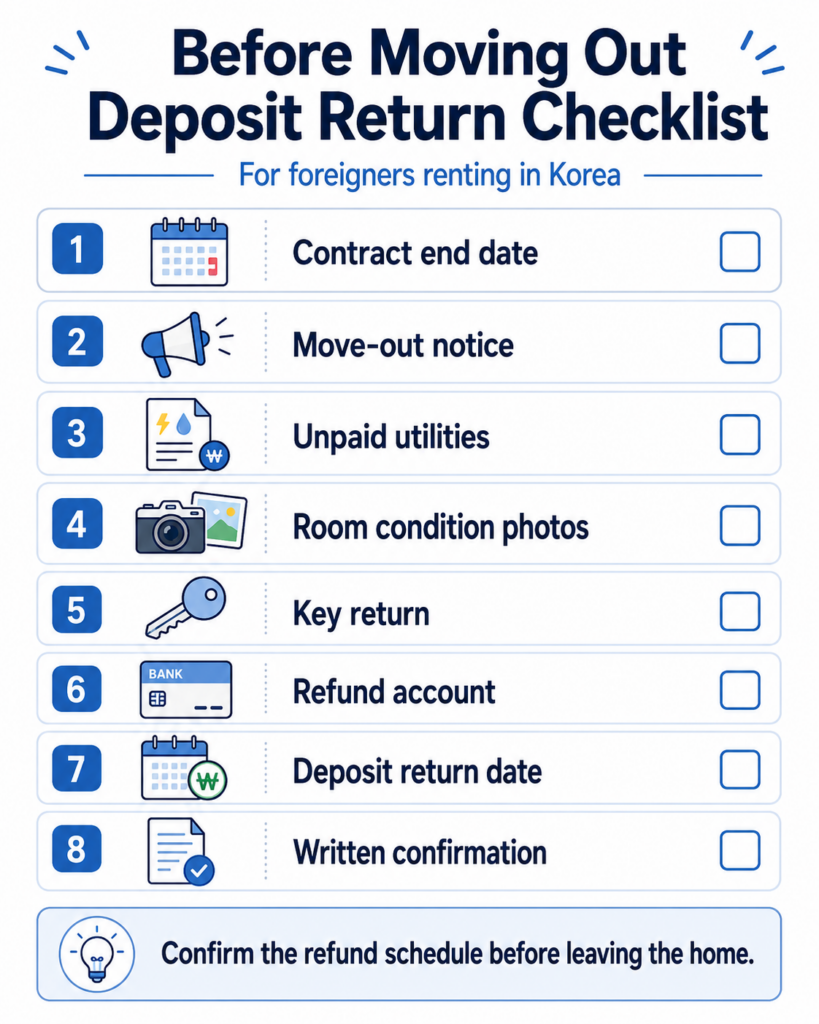
At least a few months before the lease ends, check:
Contract end date
Notice period
Move-out date
Deposit return date
Next tenant situation
Unpaid utilities
Maintenance fee settlement
Repair issues
Cleaning requirements
Deposit deduction rules
Bank account for refund
Ask the landlord early:
계약 종료일에 보증금을 반환받을 수 있나요?
Meaning:
Can I receive the deposit back on the contract end date?
Also ask:
보증금 반환 일정에 문제가 없는지 확인 부탁드립니다.
Meaning:
Please confirm whether there is any issue with the deposit return schedule.
If the landlord says the deposit depends on finding the next tenant, be careful.
You may need to prepare earlier.
Move-Out Day Checklist
On move-out day, do not leave without records.
Check:
Room condition
Utilities
Maintenance fee
Keys
Photos and videos
Final messages
Deposit transfer confirmation
Any deduction agreement
Refund bank account
Agent or landlord confirmation
Take photos and videos after cleaning the room.
Return keys only after confirming the process clearly.
If the deposit is not returned on the agreed date, keep written evidence.
If the Landlord Delays Returning the Deposit
If the landlord delays returning your deposit, stay calm but act quickly.
Do not rely only on phone calls.
Move to written communication.
Ask clearly:
보증금 반환 예정일을 서면으로 확인해 주실 수 있나요?
Meaning:
Can you confirm the expected deposit return date in writing?
If the delay continues, you may need to check official legal information.
Easy Law provides official guidance on the housing lease deposit refund process, including legal information to help tenants safely get their housing lease deposit back from the landlord.
You may need to consider:
Formal written notice
Consultation with legal support
Deposit return guarantee claim, if insured
Mediation or dispute resolution
Order for lease registration, if applicable
Civil procedure
Support for jeonse fraud victims, if relevant
The right step depends on your contract and situation.
Do not guess alone if the amount is large.
Get help from an official center, legal professional, or trusted Korean speaker.
Do Not Make These Mistakes
Do not assume the landlord will automatically return the deposit.
Do not rely only on verbal promises.
Do not pay a large deposit without checking the property register.
Do not ignore the payment account name.
Do not forget address reporting.
Do not skip fixed date or lease reporting questions.
Do not wait until move-out day to ask about the refund.
Do not return keys without clear confirmation.
Do not delete messages with landlord or agent.
Do not leave Korea before resolving deposit return if the amount is large.
Do not assume guarantee insurance is available after problems start.
Do not sign a new lease before confirming when the old deposit will be returned.
Red Flag Table
| Red Flag | Why It Matters | What to Ask |
|---|---|---|
| Landlord says deposit return depends only on next tenant | Refund may be delayed | Can you return the deposit on the contract end date? |
| Property has high debt | Deposit return risk may be higher | Can we check the property register? |
| Payment account is not landlord’s name | Payment tracking can become unclear | Why is the account name different? |
| Address cannot be reported | Foreign tenant protection may be affected | Can I report this address for Residence Card? |
| No fixed date or lease report | Protection may be weaker | Can I get a fixed date? |
| Guarantee not available | Deposit risk may be higher | Is this home eligible for deposit return guarantee? |
| Verbal promises only | Hard to prove later | Can you confirm this in writing? |
| Landlord delays written confirmation | Warning sign before move-out | Can you provide the deposit return date in writing? |
Use this table before signing and before moving out.
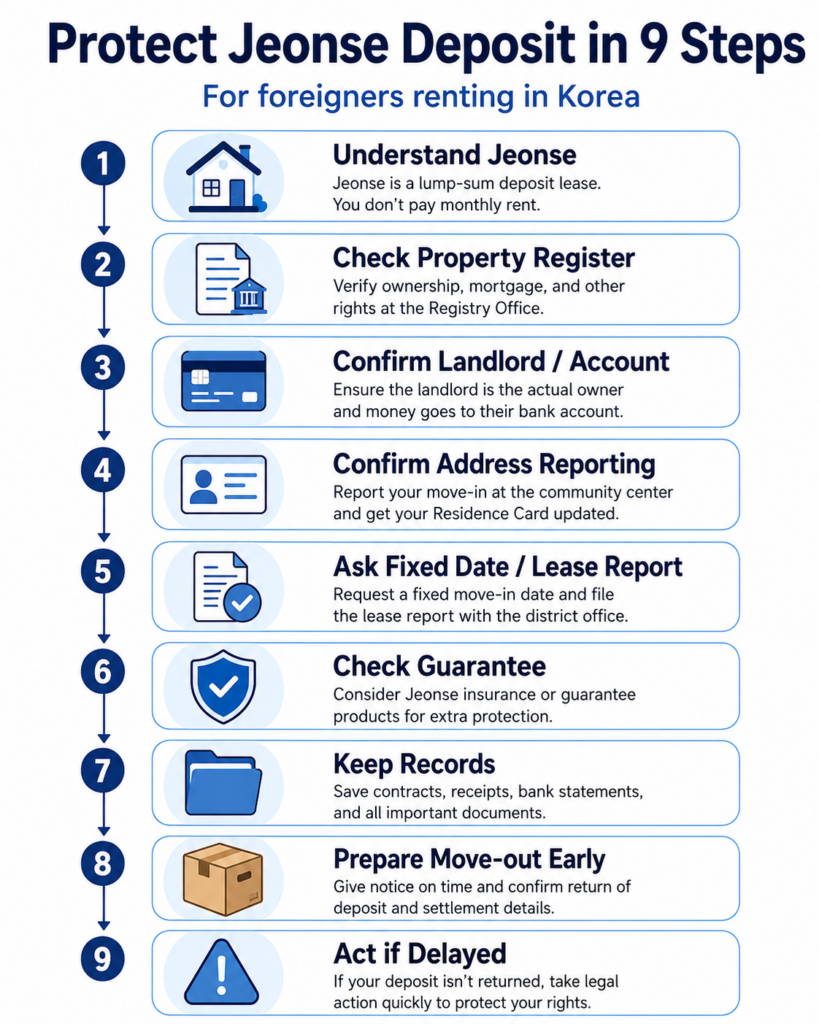
Step-by-Step: Protecting Your Jeonse Deposit
Step 01) Understand jeonse before signing
Do not sign a jeonse contract only because there is no monthly rent.
Understand that the deposit is the main risk.
Step 02) Check the property register
Ask the agent to check ownership, mortgage, senior rights, and other risk factors.
Step 03) Confirm landlord and account
Make sure the landlord and payment account information make sense.
Keep transfer records.
Step 04) Confirm address reporting
Ask whether the address can be used for Residence Card address reporting.
Step 05) Ask about fixed date and lease reporting
Ask whether the contract should be reported and whether you can get a fixed date.
Step 06) Check guarantee options
Ask whether the home is eligible for jeonse deposit return guarantee.
Check before signing, not after problems happen.
Step 07) Keep records during the lease
Save contract, payment records, photos, messages, reports, and guarantee documents.
Step 08) Start move-out preparation early
Confirm the deposit return schedule in writing before the lease ends.
Step 09) Act quickly if delayed
If the landlord delays the refund, use written communication and seek official or legal help.
Useful Korean Sentences
To ask if the deposit will be returned on time
계약 종료일에 보증금을 반환받을 수 있나요?
Can I receive the deposit back on the contract end date?
To ask for written confirmation
보증금 반환 일정을 서면으로 확인해 주실 수 있나요?
Can you confirm the deposit return schedule in writing?
To ask about property register
등기부등본을 확인해 주실 수 있나요?
Can you help me check the real estate register?
To ask about mortgage or senior rights
근저당이나 선순위 권리가 있는지 확인하고 싶습니다.
I want to check whether there is a mortgage or senior priority right.
To ask about address reporting
이 주소로 외국인등록증 체류지 변경 신고가 가능한가요?
Can I report this address for my Residence Card address change?
To ask about fixed date
확정일자를 받을 수 있나요?
Can I get a fixed date?
To ask about lease reporting
이 임대차계약은 전월세 신고 대상인가요?
Is this lease contract subject to housing lease contract reporting?
To ask about guarantee insurance
전세보증금 반환보증 가입이 가능한 집인가요?
Is this home eligible for jeonse deposit return guarantee?
To ask why the refund is delayed
보증금 반환이 지연되는 이유가 무엇인가요?
What is the reason for the deposit return delay?
To ask for the expected refund date
보증금 반환 예정일이 언제인가요?
When is the expected deposit return date?
Final Checklist Before Signing a Jeonse Contract
Before signing, check this list.
You understand jeonse deposit risk.
You checked the property register.
You confirmed the landlord is the owner.
You checked mortgage or senior rights.
You checked whether other tenants may have priority.
You confirmed the deposit amount is reasonable.
You confirmed the payment account name.
You asked whether the address can be reported.
You asked about fixed date.
You asked about lease reporting.
You asked whether deposit return guarantee is available.
You checked the contract period.
You checked early termination rules.
You checked deposit return date.
You checked what deductions are possible.
You saved every payment record.
You understand what to do if the landlord delays refund.
FAQ
What is jeonse deposit return?
Jeonse deposit return means the landlord returns the lump-sum deposit to the tenant when the lease ends.
Is jeonse safe for foreigners?
Jeonse is not automatically unsafe, but it can be risky if the deposit is large and the property, landlord, address reporting, fixed date, lease reporting, and guarantee options are not checked.
Can foreigners get protection under Korean housing lease law?
Easy Law explains that foreign nationals may be exceptionally protected if they leased a residence, completed alien registration, and reported their change of residence. Always confirm your own situation with an official or legal professional.
What should I check before paying a jeonse deposit?
Check the property register, landlord name, payment account, mortgage, senior rights, address reporting possibility, fixed date, lease reporting, and guarantee eligibility.
What is a fixed date?
A fixed date helps prove when your lease contract existed. It can matter if there is an auction or dispute involving the property.
Do I need to report the lease contract?
Some housing lease contracts must be reported within 30 days if they meet certain conditions. Ask your real estate agent or local office.
What is jeonse deposit return guarantee?
It is a guarantee product that may help cover deposit return if the landlord fails to return the deposit, depending on eligibility and provider rules.
Can I apply for HUG guarantee as a foreigner?
Eligibility can depend on your contract, housing type, visa or residency situation, deposit amount, and other requirements. Check directly with HUG, your bank, or the relevant guarantee institution before signing.
What if the landlord says they need a new tenant first?
Be careful. Ask for the deposit return schedule in writing and prepare early. If the delay continues, seek official or legal guidance.
Should I return the keys before getting my deposit?
Do not rush. Confirm the deposit return process, move-out condition, key return, and written records clearly before completing move-out.
What if my deposit is not returned?
Move communication into writing, keep all evidence, check official deposit refund procedures, and seek legal or public support quickly.
Should I use jeonse if I am new to Korea?
If you are new to Korea and do not understand the contract or deposit risk, wolse or lower-deposit banjeonse may be easier and safer to start with.
Final Thoughts
Jeonse deposit return guide for foreigners is not just about getting money back at the end.
It is about protecting your money from the beginning.
A jeonse contract can be useful, but the deposit is large. That means you need to check more than the room itself.
Check the property.
Check the landlord.
Check the payment account.
Check the address reporting.
Check fixed date and lease reporting.
Check guarantee options.
Keep every record.
Prepare for move-out early.
If the deposit is large, do not rely on trust alone.
Use documents, records, official procedures, and written confirmation.
For foreigners in Korea, the safest jeonse contract is not the one that looks cheapest.
It is the one where your deposit return path is clear before you sign.